
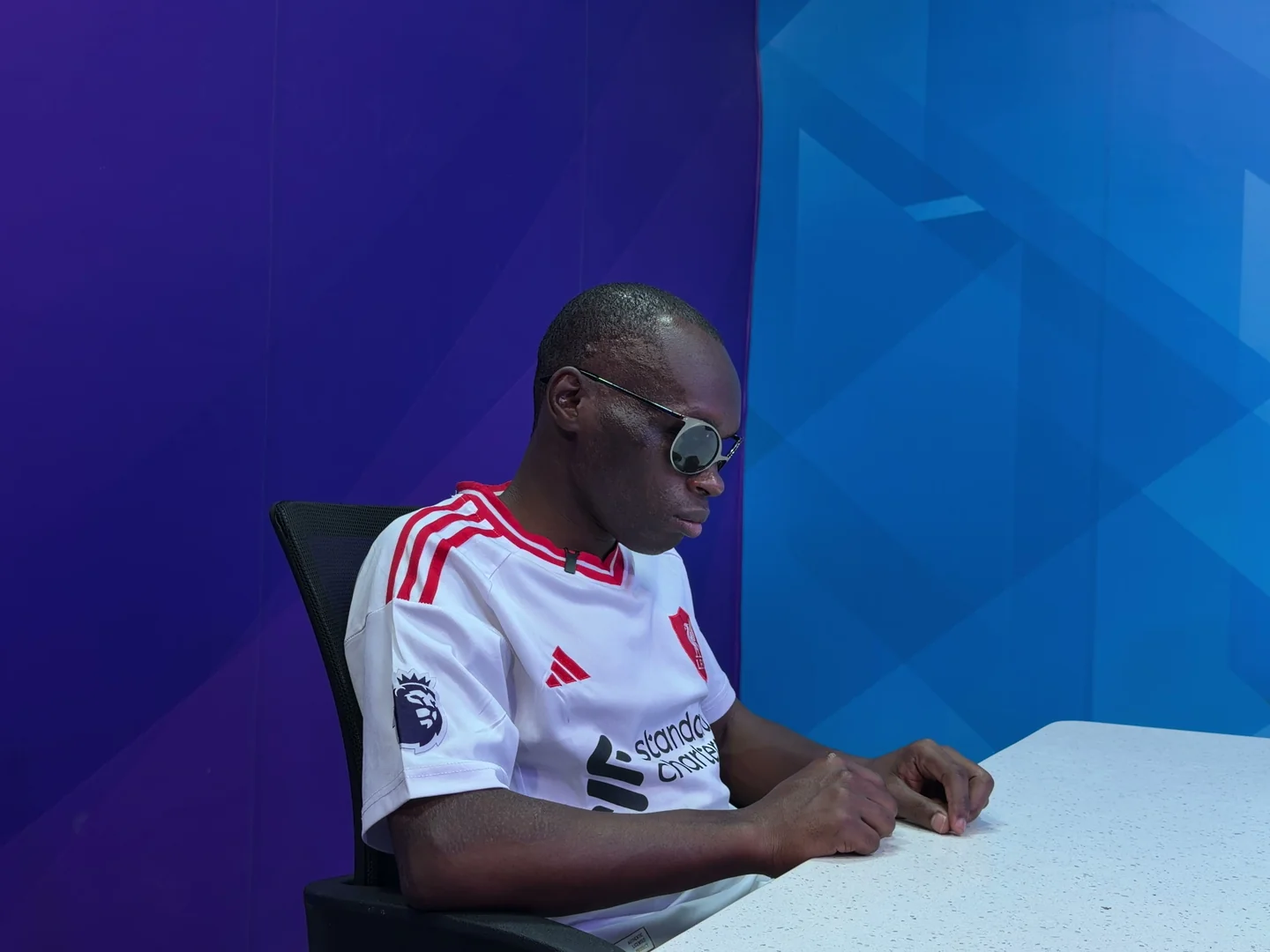
“For me, the commentators are my eyes.”
Sport
Chris Mwololo follows football by ear. “When I’m following a football match, I always listen to the commentary, and I have a picture of what’s happening on the pitch.”
He lost his sight at around a year old, and the game came to him early. “I started loving sports from the time I was young. That’s why you find I have so much knowledge about it, to the point of doing a sports show.”
On the morning of Monday 27 October 2025 he’s at the presenters’ desk at Signs TV in Nairobi. By early afternoon, Sunday’s Premier League is in his phone. He types EPL results, the phone spells each letter back to him, and then it reads the scores aloud, and he repeats them. Bournemouth two, Nottingham Forest nil. Aston Villa one, Manchester City nil. Everton nil, Tottenham three.
Device unlocked
The phone runs TalkBack, the screen reader built into Android. On an iPhone, he says, it would be VoiceOver.
“That’s like my eyes. The way a sighted person looks at their phone, for me, I listen to this accessibility feature, what it says, and then I follow. When I swipe, it speaks.”
The phone announces itself before anything else. Device unlocked. Home. It gives him the date. Two fingers up the glass and the apps arrive in alphabetical order, read one at a time: Advanced Power, AI Photo Enhancer. He listens down the list until Gmail comes round, and double-taps. A newsletter from The Athletic opens and reads itself out. He goes back. Be My Eyes. WhatsApp. Google.
“So when I touch the screen, it speaks the converted text, then I listen, and then I perform what it says.”
What TalkBack can say depends on what an app’s makers have labelled. Google’s instructions to developers ask them to label controls so a screen reader can say what they do; Apple’s equivalent test is whether common tasks can be completed without sighted help. AI Photo Enhancer announces itself by name because somebody, somewhere, typed it in.
Tech Today
The second show he presents is about the tool he’s holding. Tech Today covers assistive technology for different kinds of disability, and the last thing he looked up for it is still in the search history: assistive technology for the physically handicapped. The list reads itself out: wheelchairs, prosthetics, speech recognition software. He moves down it to a link and opens it.
“I do my research from different sources, then I combine that information, and I put it together.”
The network falters. “But that’s how I do it.”
“I can do research anywhere, as long as I have internet. Even in my house. Sometimes I just do research in the house, I write from there, and then when I come to the studio, I’m set.”
Signs TV went on air in February 2017, broadcasting in Kenyan Sign Language, and by its own account most of its programmes are hosted by people with disabilities. The station has since borrowed through Ota Growth, Sanara’s loan facility for creative businesses, which lends between five and twenty million shillings at 9% and gives special consideration to companies working with young women, refugees and people with disabilities.
News read
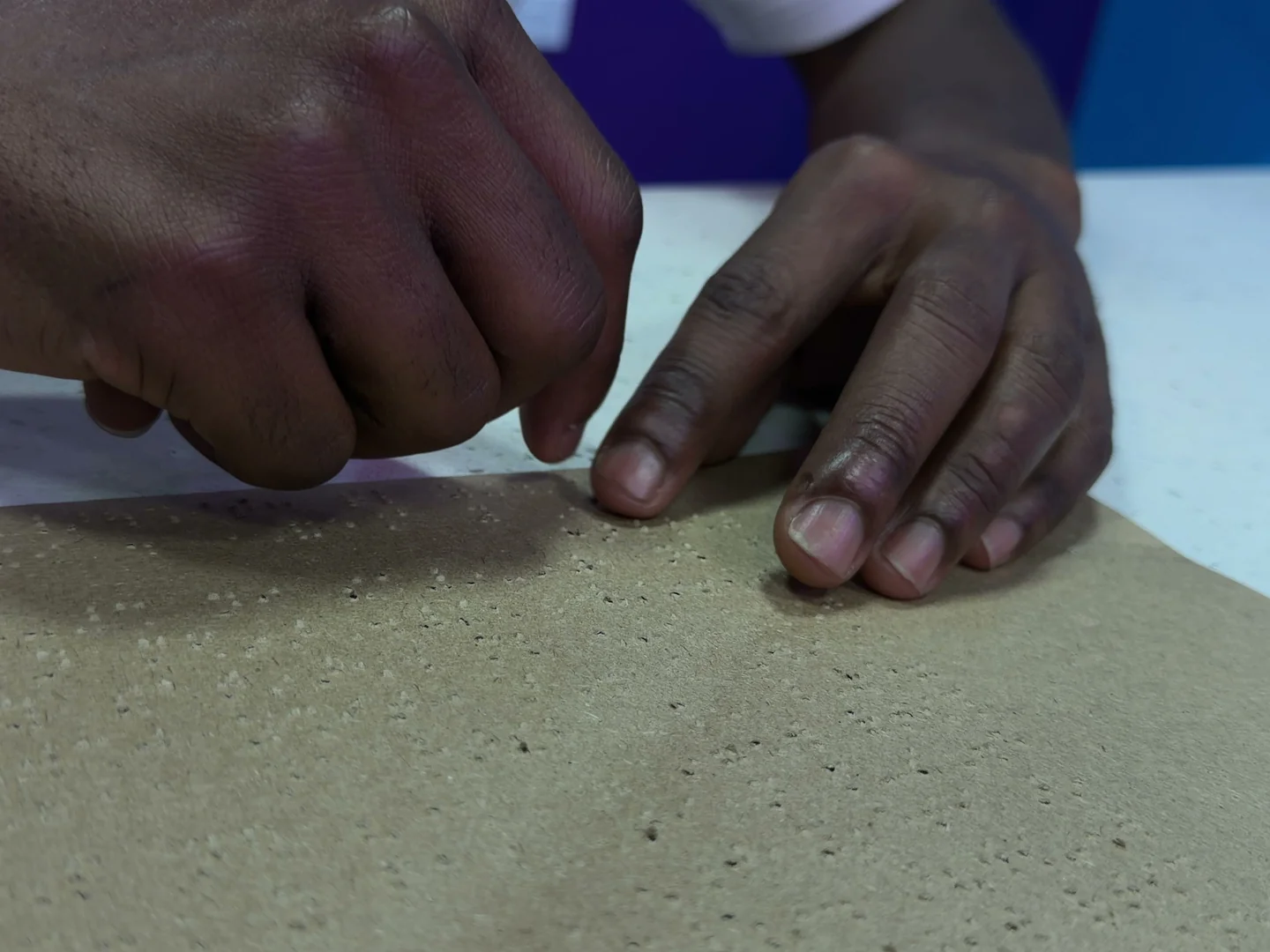
The station’s scripts come to him on WhatsApp. He converts them to Braille. Then he reads them to air.
The one in his hands is a bulletin about voter registration: the second day of a drive that had started slowly, and the electoral commission’s new system for recording citizens’ irises ahead of the 2027 elections. He reads it straight through.
The commission had relaunched continuous voter registration on 29 September. Four days in, it reported 7,048 new voters across the country. Iris capture, its officials said, was optional.
Braille dots that have been pressed flat, or caught by water, go faint, he explains, and a fingertip can’t read what it can’t feel. The dots have to stand up for him to read well.
Voiceover
The voiceover work runs the same way. “The head of production would send me the script on WhatsApp, and then I change it to Braille. After changing it, then we record.” So far it’s all been for the station. On his own time he practises.
“I just record, and I listen as I practise. Then I give somebody to listen. They analyse it and tell me if it’s good or not.”
Other people told him first what his voice was. He sang along to music at school and didn’t think anything of it. “At first, I didn’t realise I had a talent. But after listening to music and singing along, my friends would tell me, hey, you have a nice voice, you can sing.” Then music festivals, school choirs, small a cappella groups. He still sings with some of them. “Although my friends are a bit far from me. But when we get time, we meet, we sing together, and it’s something that I enjoy doing.”
Profile
He grew up the only blind child in a family that has backed him ever since. “Although sometimes I felt in a different world, because I’m the only blind member of my family. Sometimes I’d feel isolated. But when it came a time for me to go to school, and I could interact with other blind people, that’s where the journey of acceptance began.”
“But generally, life was fair. Not so bad.”
“My name is Chris Mwololo. I’m visually impaired. I’m a journalist at Signs TV. Apart from that, I’m also a trained teacher. I sing, and I can also do voiceovers.”
Sanara is a Mastercard Foundation programme delivered in partnership with HEVA Fund, SNDBX-Ubuntu, Baraza Media Lab and GoDown Arts Centre.