
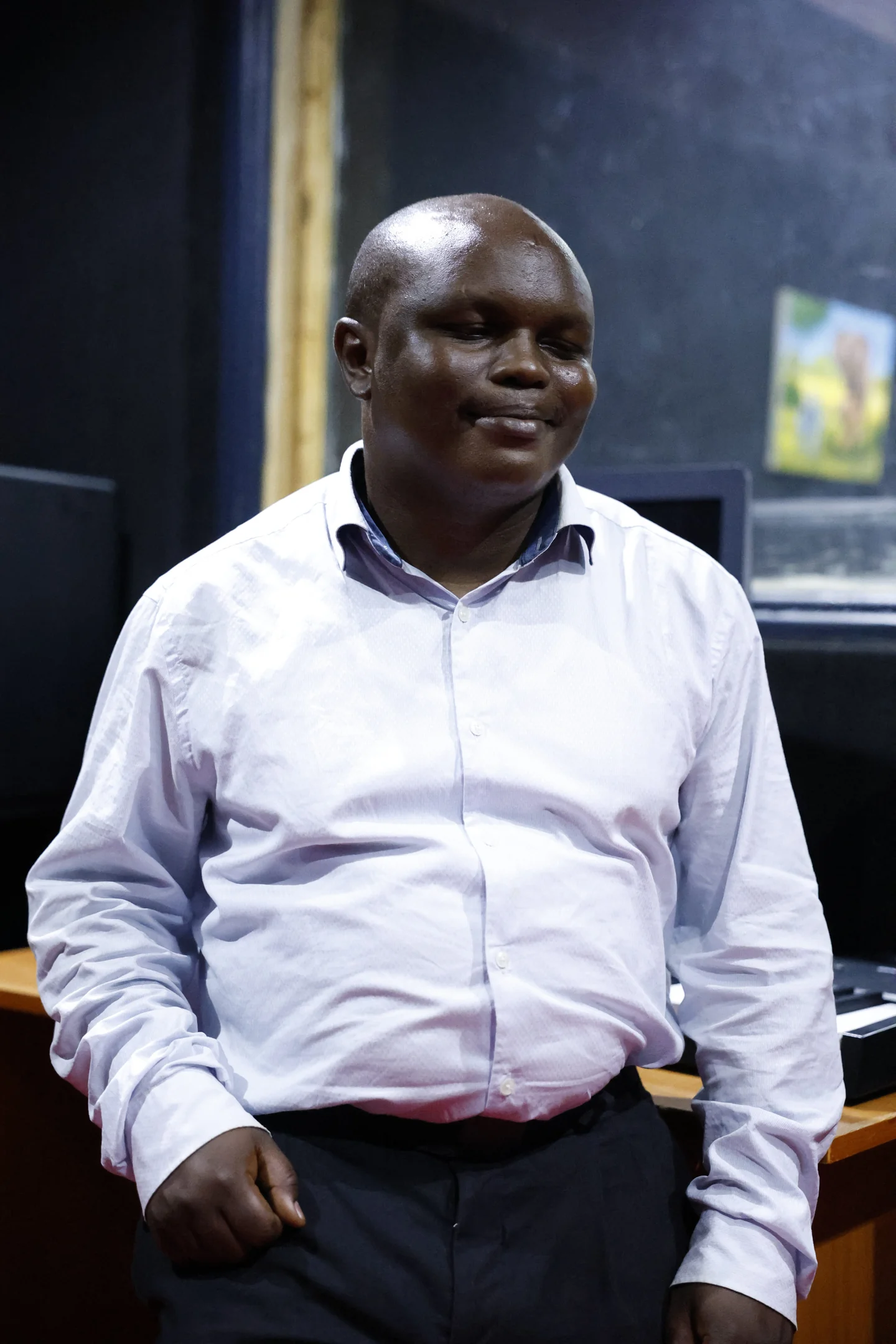
“Zile ma tins za kina Kasuku? Niko naziekanga maji.”
Dennis Murage’s first band was a row of cooking-fat tins. He’d pour a different amount of water into each, so each one rang at its own pitch, and set a metal ugali tray at the end for a cymbal.
“Like different, different tins, nazieka maji levels kadhaa, naanzia kucheza nazo kama drums. Na plus hii upande ngingine uko na sinia ya ugali, pang! So hii upande uko na tins one, two, three, four, halafu peng!”
When he was alone he’d bring a small radio close and play to it. “Naanzia kusikiza, naanzia ku-emulate. Naanzia ku-copy cha nimesikia.”
Understood
He knew early what the answer would be when adults asked the usual question. “When you grow up, what do you want to become? I knew I wanted to be a musician.” He knew why. “My life is more musical. I could easily express myself musically, and it made me feel more understood and appreciated.”
Other children noticed before the adults did. “Wengine wakienda kucheza ma-games yao, lazima wangenihusisha.” By Class 3 he was on a drum kit and singing, and the teachers were saying it out loud: “Eeh, na kijana unacheza vizuri.” In high school he formed his own choir and trained others. Then Kenyatta University, and a degree in music.
He’d known the Kenya Society for the Blind since he was a boy. It’s where families end up after the circuit of hospitals that follows a child losing his sight. “Mmeshazunguka hospitali zote, wanakutuma wapi? Hapa. Enda pale uonekwe.” KSB sent him on to school. Years later he came back as an adult, for programmes, “that is before Sanara. But now when Sanara came, I joined fully.”
Learning haishangi
He had a degree in music already, and he sat through the training anyway.
“You see, learning music, like going to school to learn something, is one thing, and doing it out here is another thing. As a musician, or rather as a human, you keep on learning. Learning haishangi, si ndio?”
University had been classical. Sanara’s trainers at KSB brought other things: pop, drumming technique, playing instruments, vocals, songwriting. He felt at home in it. Then, slowly, it became work. “Kidogo kidogo, nikapata kazi hapa. So currently pia nina-work hapa kama trainer wa computer na pia music.” He’s been gigging, too, with Pearls Band, the society’s band of visually impaired musicians, at shows and at Eugenia Park, the arts and recreation centre where KSB later held its seventieth-anniversary talent day.
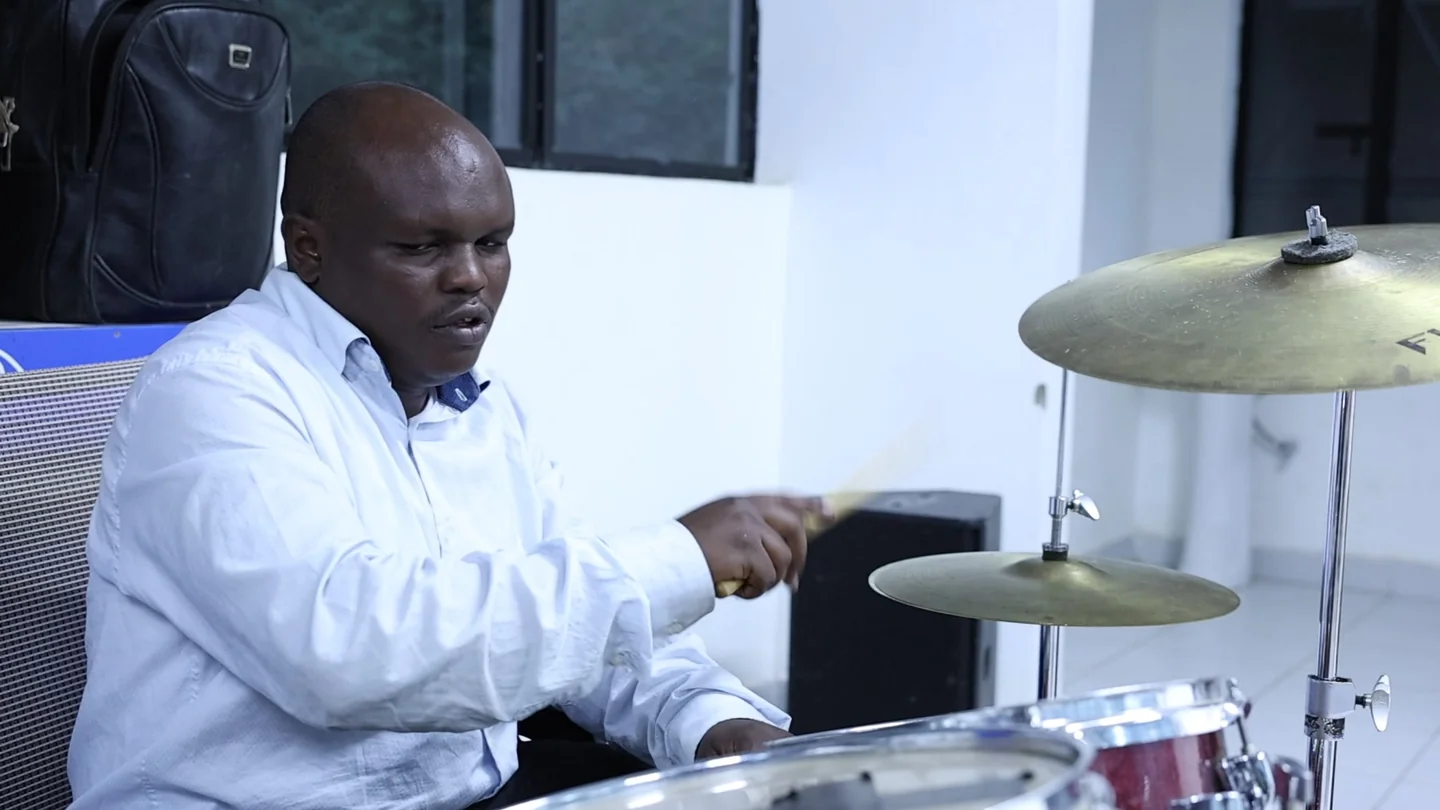
The studio he teaches in has keyboards along the wall, a pair of monitor speakers either side of where he stands, and a drum kit with strips of dark tape laid across the heads to deaden the ring. He plays it with the sticks held loose.
What he was given
What can he give a student that a sighted teacher can’t?
“I think it’s my time, my shoulder to lean on. In the sense that training PWDs is different from training, quote unquote, normal learners. We also need more, more patience. You see, for instance, you need to ensure I feel the instrument. You need to make sure I am with you at par. So I think that’s what I would give my students, ’cause that is also what I was given.”
Learners don’t arrive empty. They come with a little knowledge of their own, and sometimes it argues back. “Kuna ile unaenda kufunza mtu anakuambia, eh, sisi hatufanyangi. By the way, it’s the same, but how they do it is different.” Moving someone past that, he says, is another journey.
Some come in low, unsure what they want. “In a way, music is also therapy.” What he watches for is the moment someone stops measuring themselves against an imagined professional. “It’s not more of we ni pro mazee. It’s more of, what do you bring? The much you know is what we want.” And then: “Hey, okay. So hapa pia kuna something ninaijua. Kumbe si ati niko nyuma.”
“Tuna grow na mtu polepole, mpaka afike hiyo point fulani.” He calls it a career that’s given him more than the financial side. “Imenifanya feel more fulfilled, nikiona mtu amegrow from the much or the little they knew to something else.”
Earlier
He’d take the programme further out than its six counties. “Kuna wale wako mashinani, wenye wako Marsabit, Moyale na huko. I really wish the program ifike pia huko.”
He’d bring in instruments beyond “the normal ones”, guitar, bass, drums and keyboard, trumpets among them, and employers at the end of the training, “whereby the art industry inaweza kuwa open kwa PWDs.” The law has, on paper, started on that last one. The Persons with Disabilities Act, 2025 requires every employer with at least twenty staff to reserve at least five per cent of direct employment opportunities for people with disabilities, and to report each year to the national council on how many it employs.
And he’d start in primary school, with the children of the competency-based curriculum, which reached Grades 1 to 3 across the country in 2019 and is meant to run to Grade 12 by 2028. “Hawa watoto wa CBC wakiweza pata hiyo kitu from right there, by the time wanafika hapa watakuwa equal to their partners who are sighted.” His plan for who teaches them is people like him: former trainees, posted to schools as Sanara trainers, nurturing talent “right from that tender age.”
“By the time wanafika high school ama university, ama out here, wako at least somewhere better.”
For himself, he wants to go further. “I still wish at one point in life niende nje ya Kenya. I love exploring.”
KSB’s executive director, Samson Waweru, put the institution’s version of the argument to the government and corporates at the society’s talent day that week, as it marked seventy years: “Our next chapter is about turning talent into opportunity, creativity into livelihoods and inclusion into economic participation.”
Joined together
What KSB has changed by existing, Dennis says, is perception, though not everywhere.
“Kuna ingine bado wakiona mlemavu, or rather mtu mwenye ako na sight issues, anaona huyu ni mgonjwa, hasikiiangi.”
“I’ve never understood why sight and hearing are joined together.”
KSB has been a voice, he says. “For those maybe wenye wamefichwa. Wajua bado kufichwa iko real.”
Disability Rights International heard as much from parents across Kenya in 2018: children with disabilities were “still being hidden in homes because of community attitudes and stigma”.
“So for those wenye wamefichwa na wako nyumbani, at least sasa watu wameanza kutokea. VIs wameanza kujipenda. Sasa VIs wameanza ku-interact na ma-sighted people.”
Sanara is a Mastercard Foundation programme delivered in partnership with HEVA Fund, SNDBX-Ubuntu, Baraza Media Lab and GoDown Arts Centre.