
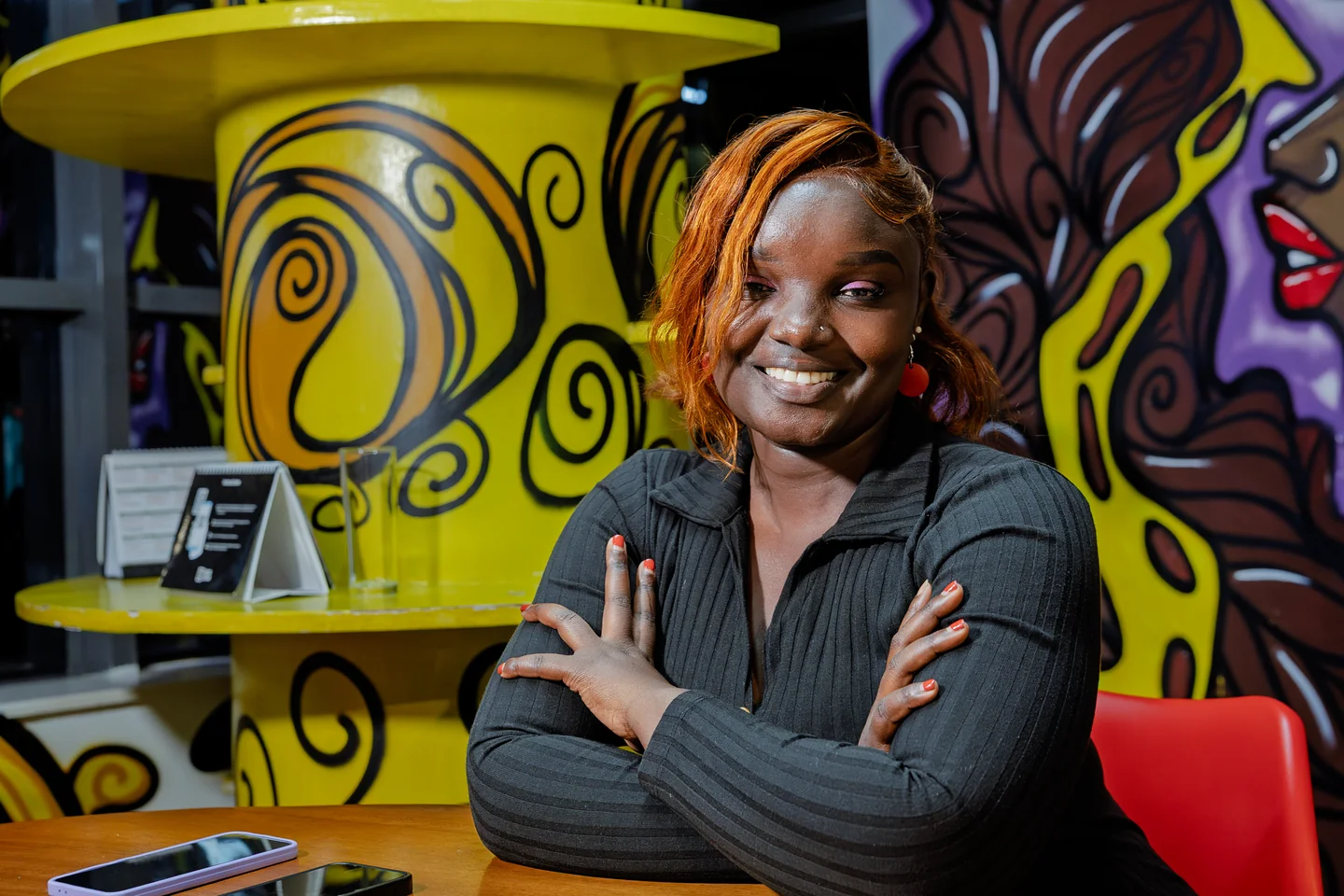
“It’s quite hard. It’s quite hard, but at the same time it’s nice. Because you’re the one making decisions for yourself. You’re the one who knows exactly what you want. So you have to, ukisema ni hivi, ni hivo. You have no one to tell you, no, don’t do that.”
DJ Jacy is talking about the years since COVID, when she stopped working inside someone else’s operation and started booking herself. “I did cabin crew,” she says. “Besides that, I still had the passion for DJ. So I decided to go for what I wanted and what is in me, which is music.”
In 2018 she spent two months at Genius DJ School, the academy run by DJ Sadic, a gospel DJ with a Groove Award and television shows behind him. When the course ended she stayed on and worked with them for about a year. Then the pandemic. “During COVID, I left, and I started being on my own.”
Being on her own meant starting again from the bottom. “You’ll get free gigs a lot. Someone will tell you, oh, you never know who will see you there. You’ll be paid with exposure. Sometimes you’ll be paid with transport. But you have to start from somewhere.” A year after the campaign, SNDBX-Ubuntu, which runs Sanara’s business training, profiled a Kisumu creator from its alumni who had started out the same way: expensive data, little gear, and being “paid in exposure”.
“You get to a point where now they’re the ones calling you. So of course, ukiitwa, unalipwa.”
Mentions
In 2025 Kikuyu Love Sessions, the Nairobi concert series built on love songs in Kikuyu, went looking for women who DJ in the vernacular. There would be no judges. Finalists’ sets would go up on YouTube, the audience would watch, and the most-watched after twenty-one days would win a slot at the next edition.
“When they posted, I really got a lot of mentions from that post. I was like, okay, so what do we do from here?”
Then a friend, also a DJ, sent the screenshot. “Akaniambia, go try this thing. I did a brief introduction of myself and sent a link of my mixes. And then, by the grace of God, I say.” She was chosen.
The set that came out of it runs a little over thirty-two minutes. She plays outdoors, against a fence of grey wooden slats, under three tie-dyed T-shirts hung on hangers, purple running into pink. Her own T-shirt is black, with DJ JACY across the chest in yellow capitals. Headphones on, a microphone on a stand at her shoulder, a controller and a mixer on a table draped in black. The songs are in Kikuyu.
“This was all about you pushing for you to get the views,” she says.
I have my own
Late in the campaign the terms changed. HEVA Fund announced a professional DJ starter kit for each of the six finalists, through its Starter Kit Grants, with business development training to follow through Sanara’s partners.
“It was nice. I was like, oh, okay. It was a good feeling, and it shows that they really are into pushing someone to the next level.”
It was called a starter kit.
“Personally me, at some point, it will help. But for me, I have my own. I have my own machine.”
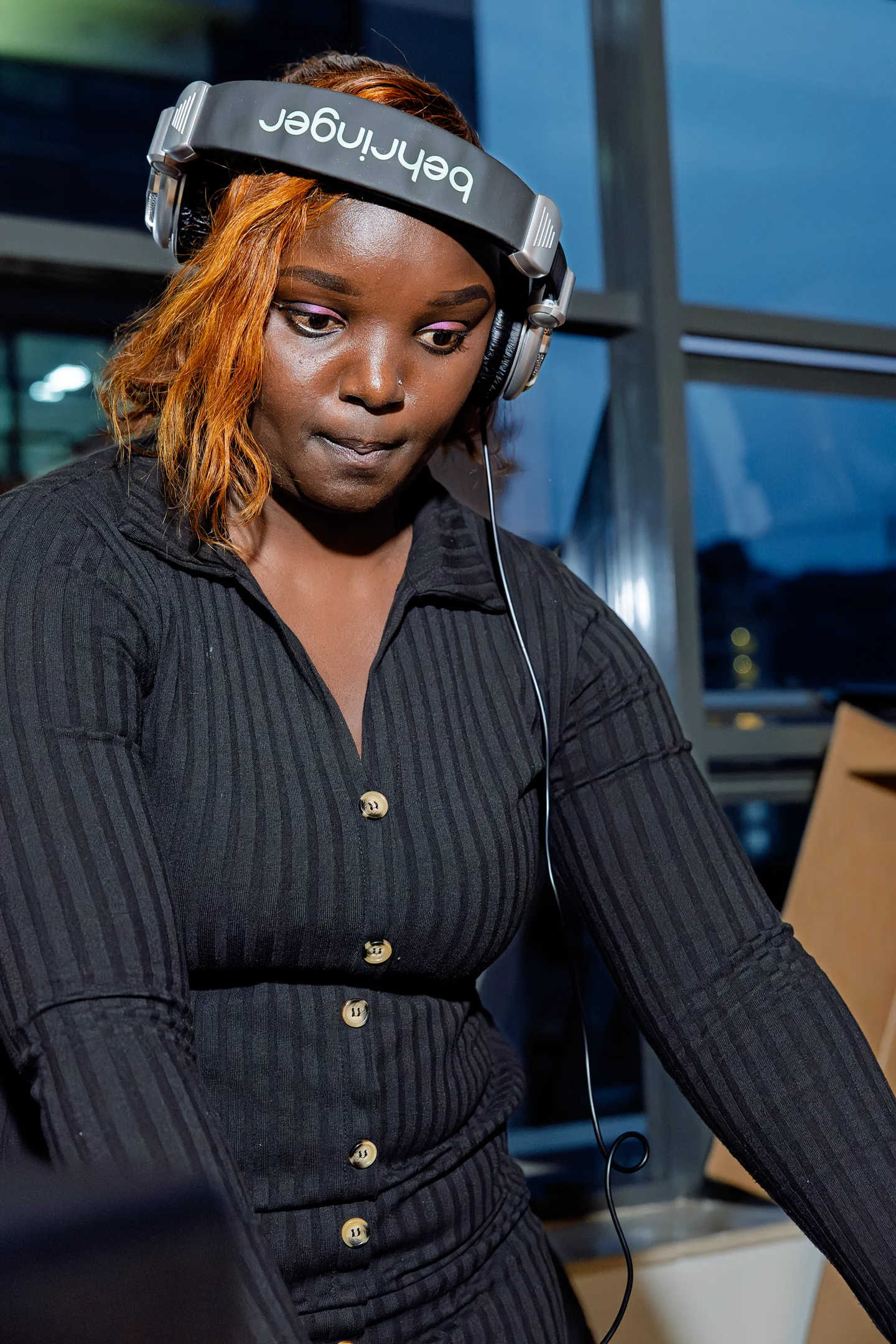
Fifth to speak
That evening at Baraza Media Lab she’d been the fifth finalist to speak. She took the microphone and thanked God before she thanked anyone else. “First and foremost is to thank God for the opportunity that he gave us. To meet you guys and to know you.”
Then she told the story of the poster again, in Kiswahili this time and with more people in it. A friend sent it; she hadn’t read it. Later another DJ phoned to ask whether she’d tried. Not yet, she said. So she recorded, that first recording, and sent the mix. She thanked Kikuyu Love Sessions, and HEVA and Sanara. She said being women was a plus. What they were short of, she said, was a push, the kind that could carry them a long way, if they could get it. “We’ll get there.”
“You can follow me on all my social media platforms. Instagram, YouTube. I will appreciate the love.”
Head high
“Just know that the fact that you’re a female, it’s a plus. In as much as it’s hard, it’s a plus at some point. What you need to do is keep your head high, know the direction that you want.” And: “Just know that the industry is not soft for us female DJs. You have to be very, very courageous, and you have to have discipline.”
“I’m hoping for the best. I keep pushing each day at a time, doing the right thing, keeping God first, like I said. Branding. Doing more mixes.”
In October 2026 a Kikuyu food, music and culture festival in Murang’a, Chai wa 14, put DJ Jacy on its line-up, beside Musaimo wa Njeri, his son Mungai, and Mike Rua.
Sanara is a Mastercard Foundation programme delivered in partnership with HEVA Fund, SNDBX-Ubuntu, Baraza Media Lab and GoDown Arts Centre.