
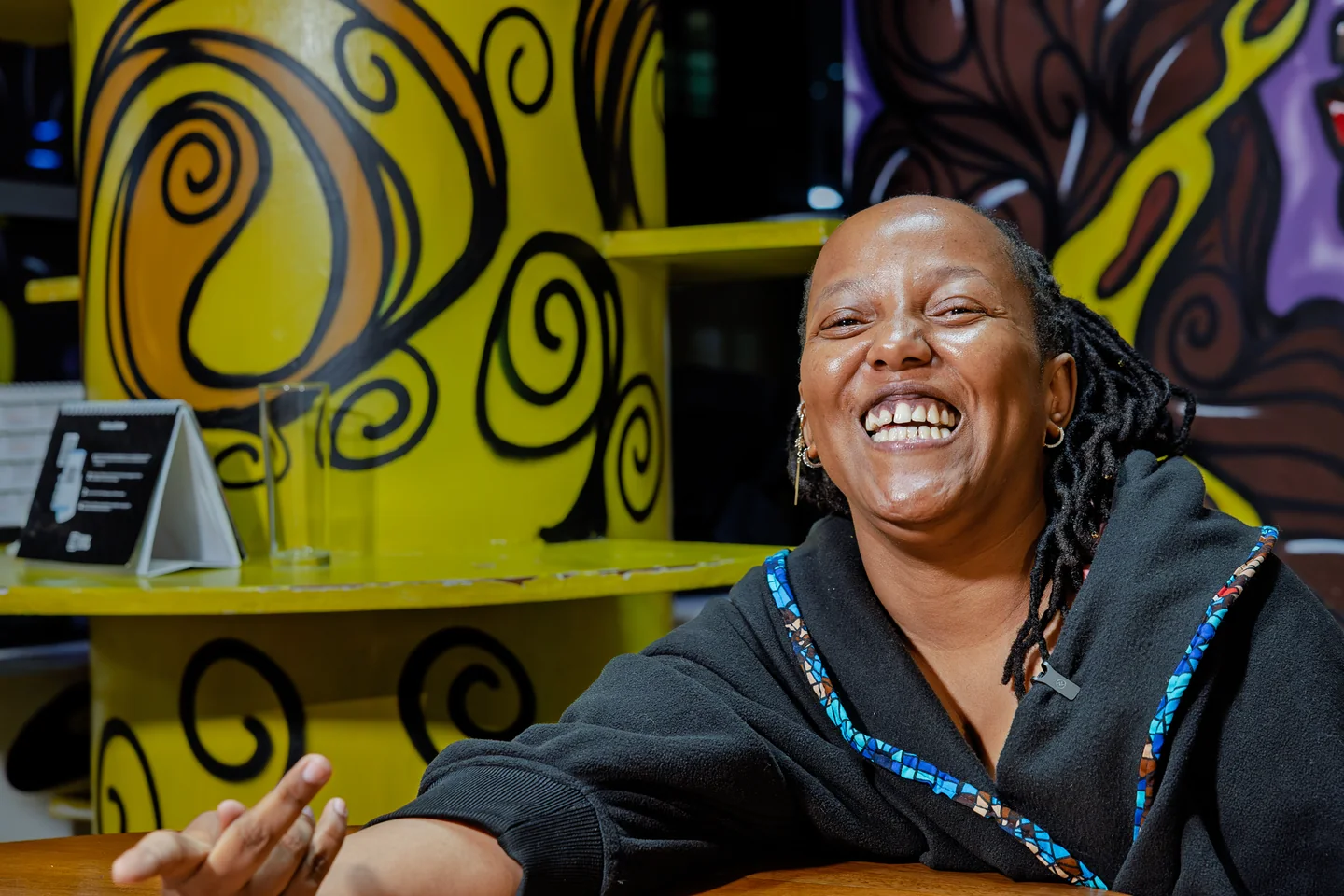
“I love music.”
DJ Wiwa says it first, and then the voice beside her says it again. Earlier that afternoon at Baraza Media Lab, on the stage, the second voice had set out the arrangement: “She speaks, I echo.”
“And my mom knew I love music,” she says.
The echo carries it across and adjusts one word. “And her mom, our mom actually, knew of her love for music.”
“So she suggested I should take DJing as a career. Since I cannot sing.”
There had been a choir, once. “I was in a choir in primary school.”
Talanta
She and her mother had been selling jewellery door to door around home in Mwea, Kirinyaga, and in 2018, with some money saved, her mother proposed DJing. “I do not remember my exact response, but I did laugh,” she wrote. She knew a few female DJs in Kenya and, she wrote, none with her condition. In June that year, with someone to help her, she travelled to Nairobi for the first time and enrolled at Talanta Institute. She finished in October.
The floor
After the course she came home with no decks of her own. So she went to the clubs.
“They said, ‘Oh, they can’t be on the floor.’”
The echo gives the fuller version: “No, our decks or machine cannot be put on the floor.”
“That was a challenge.”
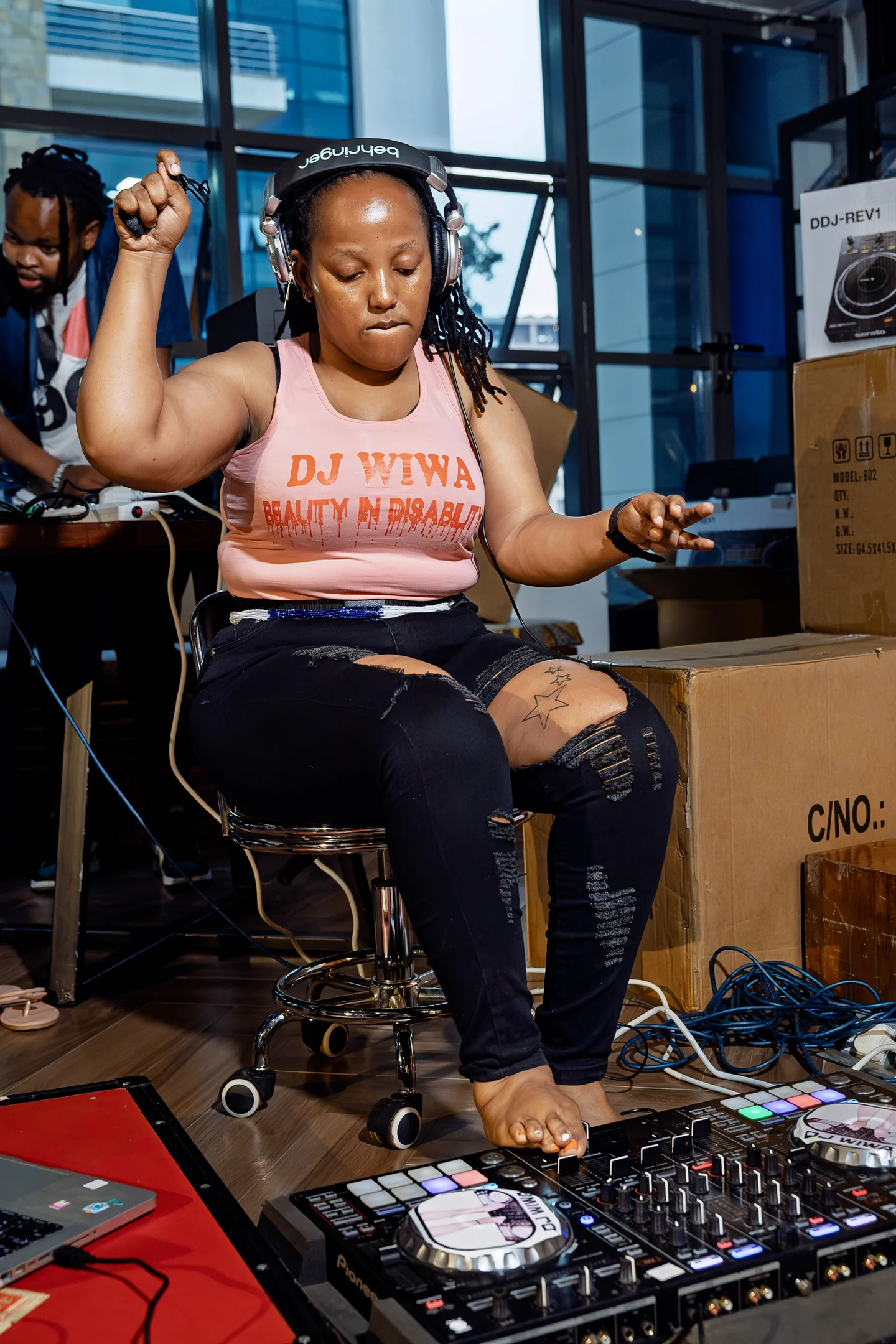
She had already worked out how she plays, and she has described it exactly. “I DJ with my legs, my hands in the air, and my feet on the equipment doing the mixing. I control my balance on the seat, towering over the DJ equipment on the ground. I put one foot on my laptop and the other on the decks. With my toe, I press play.”
What the clubs were refusing has a name in law now. The Persons with Disabilities Act of 2025 counts the denial of reasonable accommodation as discrimination, and defines that accommodation as a necessary modification that doesn’t impose an undue burden. A controller on the floor is about as small as a modification gets.
Other DJs did what the clubs wouldn’t. “And they gave me the DJ decks,” she says. “For me, that was a welcome to the industry. Because instead of giving fish, they gave me the fishing line.”
A thousand bob
The first paid gig came the next year, on Valentine’s Day.
“I was paid a thousand bob. That thousand bob, my mom was the one who received it.”
Her mother remembered something her daughter had said: that her first salary would go to God. “And so I was forced to take the money to church.”
In 2021 she wrote one more line about her mother. “My mom was my number one fan, but she died in 2019 on Christmas Day.”
Then, in the echo’s words, “corona quickly came.”
Corporate
She kept working through it, on virtual events and her own videos, and set herself a target. “I plan to work harder in landing corporate shows to broaden my fan base,” she wrote that year.
By December 2024 The Standard was listing where she’d played: corporate events for EABL, the She Leads Girls Summit at the African Union headquarters in Addis Ababa, Rwanda several times, the UN day for persons with disabilities at Uhuru Park as official DJ. On the stage at Baraza in October 2025 she put it in a sentence, and the echo gave it back to the room.
“So now I am a corporate DJ. Because corporate want inclusion.”
“Then I show them that I can. And do it better with my feet.”
In the same Standard piece she described a booking she’d had more than once: “At times I am hired to perform in an event and they bring a backup or support DJ, who has no disability, yet I end up performing longer, because I have good experience and grasp of instruments, and later paid less.”
Sanara, the programme behind the starter kits, lists fair and safe work as one of its four pillars, led by GoDown Arts Centre: “promoting policies, job recognition, and protections for creatives.”
Every six months
It’s Her Turn reached her the ordinary way. “On a Sunday, I was going through Instagram,” she told the room. She saw the Kikuyu Love Sessions post, applied, and forgot she had. “I am ambitious.”
When the competition ended in a kit for every finalist, she said what hers would replace. “Because after every six months, I have to take it to the repair.” Her headphones, the echo adds, were not working. “Now I see God works in many ways.”
At Baraza she plays with cardboard cartons stacked behind her. The controller on the floor is her own, an older Pioneer sitting in a flight case, and both its jog wheels are covered with stickers: DJ WIWA, and under the name a photograph of two bare feet on a controller. Her laptop rests on the case’s red lid beside it. She is on an office chair above them in a pink vest that reads DJ WIWA and, beneath it, BEAUTY IN DISABILITY, toenails painted orange, one foot on the keys and one on the mixer, headphones on, her hands in the air.
With the new gear, the echo says, she can go online and make mixes, “which was quite a challenge.”
“Now it’s possible,” she says. “I love it.”
“I always encourage myself by occasionally whispering and reaffirming, ‘You are the queen of the decks.’”
Sanara is a Mastercard Foundation programme delivered in partnership with HEVA Fund, SNDBX-Ubuntu, Baraza Media Lab and GoDown Arts Centre.