
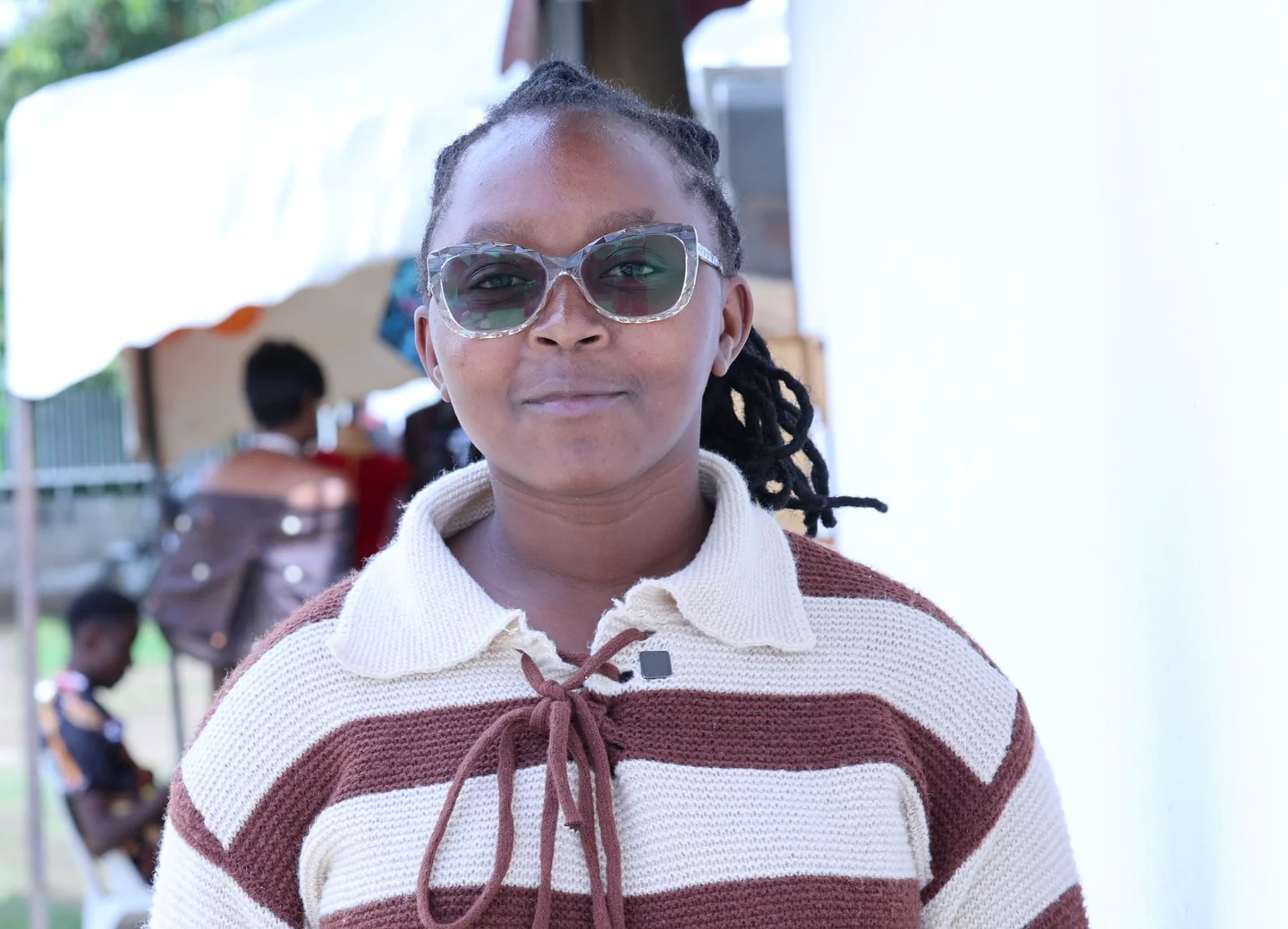
“My brand is called Beads by Felicia, where I deal with pearl-beaded handbags, Kenyan-beaded bracelets, anklets, waistbands and many others.”
She has the line ready, name first and then the stock, the way you'd say it to someone who has stopped at your table and might walk on. Felicia Wanjiku is 22, a bead artist from Nakuru, and in June 2025 she's standing in front of a row of white market tents at an SNDBX-Ubuntu gathering for Sanara in the town. There's a newer line behind the list. “Like right now, I’ve started making beaded handbags, tops.” And another she isn't showing yet, which she says will be out before the end of the year.
The beads in those handbags have come a long way to reach her. The glass seed beads that Kenyan beadwork is known for came first through Venice and Bohemia; the anthropologist Vanessa Wijngaarden notes that, to this day, they're imported from the Czech Republic, and one Nairobi firm has been the main importer of Czech glass beads since 1976. Felicia learned to work them from a man her mother took her to, in a year when nobody was in school.
She was in Form Four when COVID shut the schools. The order came on 15 March 2020, and more than 17 million learners missed over six months of classes. Her mother found the man, he taught her the basics, and on 12 October, when Form Fours went back, she went back with them, finished, and left the beads where they were.
“Beading was not that - I did not like it that much. So after I finished Form Four, I looked for jobs.”
One was waiting tables at a hotel. They wanted her in at six, and the bosses, she says, could be rude. “I was not that comfortable. Waking up earlier, going to work. I was not feeling it.” Then one of them took her phone.
“That’s where I knew this was not for me. It was not meant for me. So I just quit that day.”
The second time round nobody took her to anyone. She taught herself from her screen. “I started beading skills going through YouTube and Pinterest.”
“It was not easy, especially getting back your old clients. Getting the capital, the old customers, starting to renew yourself, like you are starting back from zero.”
So there had been customers, the first time, the year she didn't like the work, and they hadn't waited for her.
When Sanara's partners presented their findings in Nairobi in July 2026, they named access to finance as the biggest challenge creative businesses face. They reported that 63% of the businesses the programme had financed were led by women, and that about 30% of its borrowers had never borrowed before. Those are the programme's own figures.
“The job was not paying that well, and I was feeling tired, exhausted, like I wanted much more. I was putting so much pressure on myself. I have to make it, I have to be known by many people. So it was very hard and difficult.”
She went to her mother, who had found her the first teacher.
“She told me, ‘No, no, no, no, no. This is you. This is who you are meant to be.’”
“My beading skills were terrible. But I thank God I’m here.”
“So one day I just decided to pick myself up. I washed my face and said, ‘Felicia, no, you are not supposed to be like this. You are supposed to go far. This is you. This is who God meant you to be.’”
“Your work, even though it’s not that big, you can start with doing a brand this small, and it’s going to go far. In five years from now, I’ll be far.”
Sanara, as she counts it, brought her other people. “I can say I’ve met new people. I work with some people, like other bead makers.” She's one of the secretaries of a group she calls 254 Beaders, which she says runs across Kenya. “I’m glad to be there.”
“Beading is not easy. That’s the one thing you should know. Even me, when I started, I didn’t love it that much. You have to have consistency and discipline so that your brand can grow.”
“And for the person who is a woman, she should not give up. She should continue doing it, and loving it, and you have to do it with passion. Don’t just do it because you want it. You’re supposed to do it because you love it, so that more people can be able to see your work and see what you are doing.”
“By the way, I’m a shy person.”
“Your shyness will not take you anywhere. You have to talk, be courageous, show your work so that people can know you.”
“At least I am building that.”
Sanara is a Mastercard Foundation programme delivered in partnership with HEVA Fund, SNDBX-Ubuntu, Baraza Media Lab and GoDown Arts Centre.