
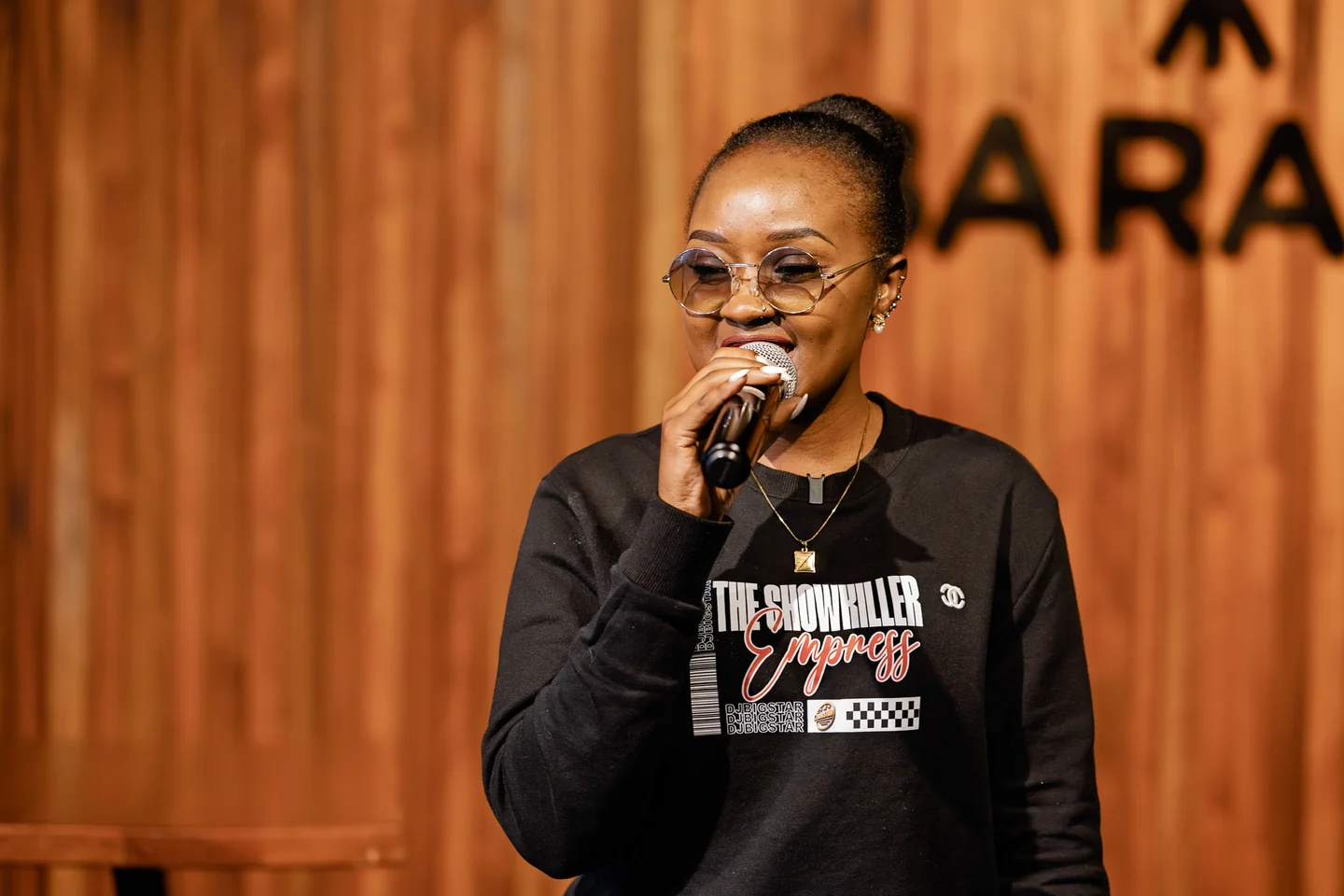
“Let me say, I’m a woman of very short words, but not -”
She doesn’t finish it. DJ BigStar has come down from Nakuru for this, and she’s at the front of a room at Baraza Media Lab with a microphone in one hand, tinted glasses, hair pulled up, a black sweatshirt with THE SHOWKILLER across the chest, Empress in red script underneath, and DJBIGSTAR printed three times down the side. She has already thanked Kikuyu Love Sessions, and said she’s glad “they didn’t give up on us, regardless.” “So what else, what else?” The partners. The kits. The refreshments. Her handle, on all her platforms.
Plates
Years before any of that, she rehearsed over the washing-up.
“I kept on telling myself, when I was doing dishes at home, one day I would want to spin. So I would do plates like this when I’m placing the cups. And I’m like, yeah, I love this thing.”
The DJs came through the radio. “Kitambo kidogo, we didn’t have television. Through those shows, I would hear various DJs and I’m like, ah, I love that DJ. One day I’ll come to learn that skill.”
Her father set the terms early. “My dad used to tell us, I’m going to support you however I can. Any other thing that you would like to do, you can do it peke yako, when you have your own money. If there’s a skill you’d like to add, najilipia juu.”
So she waited for her own money. High school, then college. Then she searched: “I’m on Google, I’m searching Nakuru, Nairobi, where, where.” The school she chose was one she’d been walking past, stopping to talk to the people inside, who kept asking whether she wanted to start that day. “I’m like, no, I’ll come.”
When she came, she came with the fee.
“I told the teacher, I want to pay today. Can we start tomorrow? So he told me, whenever, Bigstar, whenever you are ready. Ah, mimi kwani ni kesho. It was like a weekend. I was like, Monday, I’m reporting here. What time? I was like, eight on the dot. I’ll be on this door.”
She was.
“Nikaenda class, the teacher was like, ah, ulikuwa serious? I was like, yes. Let’s do this thing. Tunaanza wapi? Tunakaa chini ama huku tunasimama?”
Three months, paid for herself, and not long ago. “Last year, funny thing. I’m just one year old, let me say that.”
Polepole
Finishing the course didn’t bring work, not yet. “DJing is like any other course. You get to learn polepole, you brand yourself, and now when people know you, people start giving you jobs.”
So she went where people were, with small reels on TikTok and Instagram. By the platform’s own advertising tools, 15.1 million Kenyan adults were on TikTok at the start of 2025, just over a third of them women, and one of the women was posting from Nakuru. The messages followed. “Oh, I saw you’re a DJ on TikTok. Eh, will you come to my event?”
The first money wasn’t much. “It was small, but humble beginnings. I’ve started something, and yes, I know I’m going far. Polepole tu.”
Nakuru keeps its own circuit, in a town that became Kenya’s fourth city on 1 December 2021, a few weeks after UNESCO named it a Creative City for crafts and folk art. At one of its events, at Afraha, the town’s stadium, the DJs were up against the MCs, and she was sitting with the other DJs, cheering her side.
“Behind me, someone tapped me and asked me, oh, hello, hi, I love what you do on TikTok. I saw you. I was like, oh, hi. So I just thought maybe this is a fan. We didn’t even exchange contacts, because this is a dude. First time meeting, like, yeah.”
Later, a call.
“Hello, Bigstar, my name is so and so. There’s something I would like you to try. It’s like a competition. I was like, oh, and who are you again? So he told me, you can’t remember me. I didn’t tell you my name, but I told you I love your work.”
He sent the details of It’s Her Turn, Kikuyu Love Sessions’ search for women who DJ in the vernacular. She read them. “This is what I was looking for. Let me try this thing.” She told her teacher.
“He told me, you know what? Bigstar, you’re passionate, and I believe in you, because the moment you stepped into this school, I saw it in you. So go for it. Let nobody tell you nothing. You’re meant for this space.”
The window
The prize changed before anyone had won it. Six kits instead of one: HEVA Fund’s starter kit grants for every finalist, with business development training through Sanara’s partners. “I’m like, wow, all right. Hey, si twende. Let’s get this thing. I think that is a door of new opportunities opened for me.”
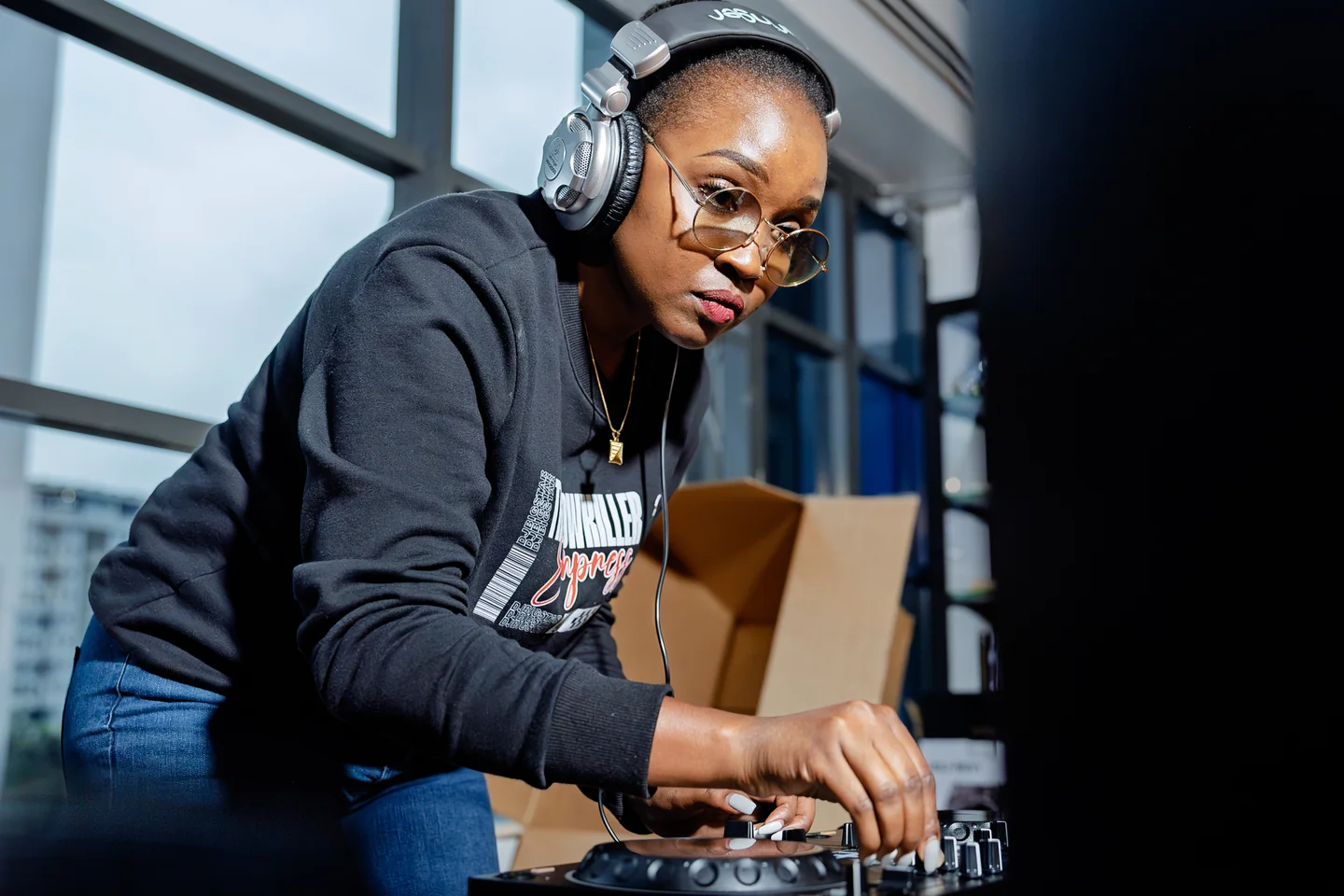
That afternoon at Baraza she leans on her boxes, one elbow on the speaker cartons, before they’re open. Then they are: a laptop, a Pioneer controller, a monitor speaker with its cone facing the room, and her at a long window with the city behind her, silver headphones on, the Empress sweatshirt.
“Kwanza, I’m hoping for very, very, very many gigs. Kwanza this time, festivities. November, December.” “My name is out there because of the competition. Everyone wants to know who is this Bigstar, what is she doing.”
Allan Gitau, who runs Kikuyu Love Sessions, was quoted in the funder’s announcement a month earlier with a hope of his own: that Kikuyu promoters and event organisers would now be open to booking the six “for the gigs they deserve.”
For her the deal had already arrived. “100%. This is so worth it. This is like something you’ll be telling yourself, kuna deal unangoja ivane mahali. This is that one deal.”
Flow nao
At the window she goes into the music for a while, all the way in, and then comes back up and finds the room.
Did someone tell her to do that?
“No.”
“So my teacher used to tell us, usijibambe peke yako, angalia mafans. Kuna watu wanaenjoy muziki. Flow nao.”
Sanara is a Mastercard Foundation programme delivered in partnership with HEVA Fund, SNDBX-Ubuntu, Baraza Media Lab and GoDown Arts Centre.