
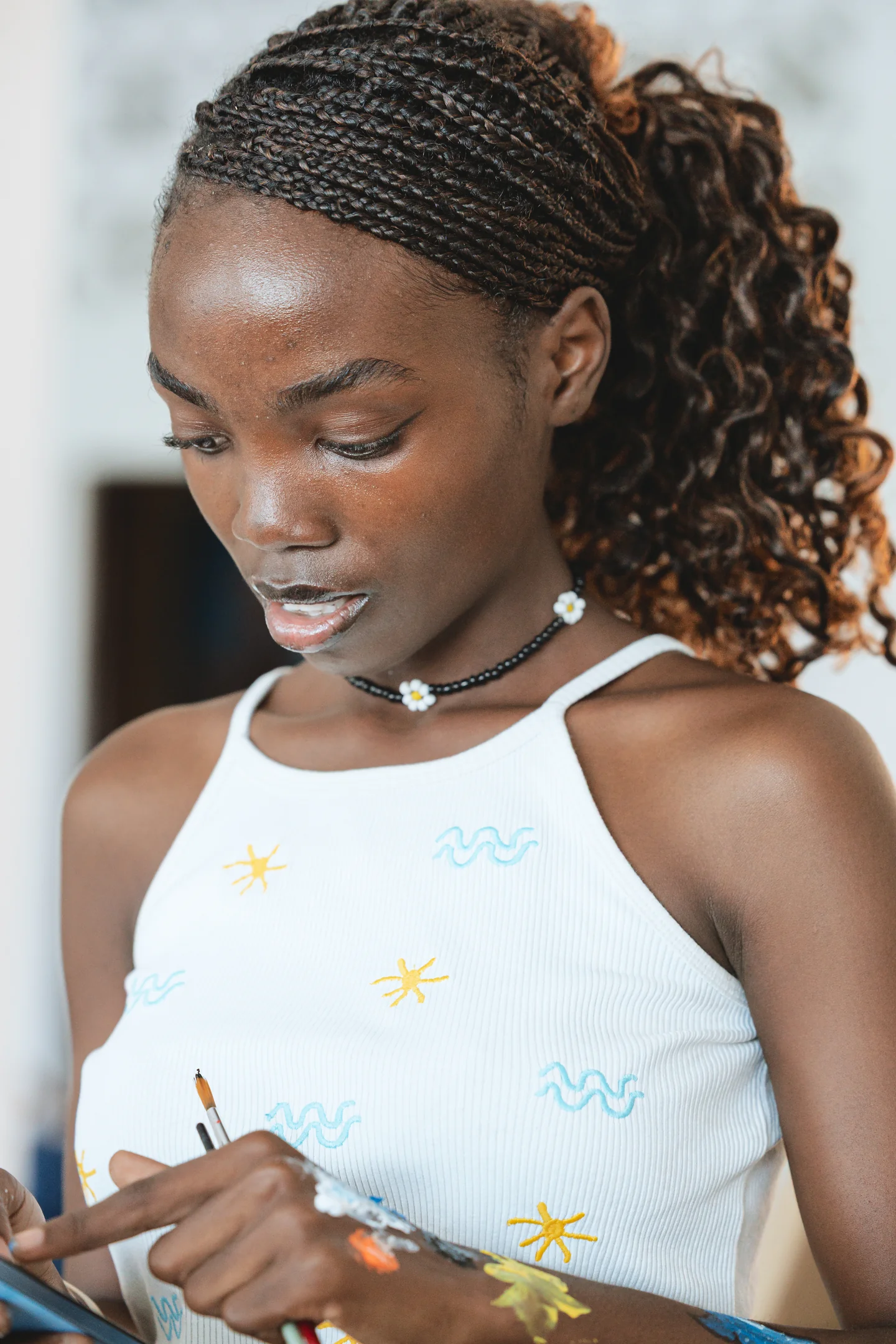
“I do face painting, crochet, sketching, painting. A lot of things. Vitu mingi sana.”
Grace Lavina is working while she says it. It’s the day of the Sanara graduation in Mombasa, 20 June 2025, and a man sits in front of her with his face given over to her brushes. Somewhere behind them the ceremony is reading out names. She keeps half an ear on it for hers.
She’s finished at Pwani University. These days, she says, she’s “just an artist.”
Something simpler
She wanted to tattoo first.
“Then I realised tattooing is more spiritual than whatever I wanted to do. It needed a lot of energy. So I decided to do something that is a little bit simpler, and then I could engage with kids more, because tattooing involves a lot of adulting and everything.”
Face painting and body art came in 2024. One of the jobs that year was at Kisima, a wellbeing festival held in a baobab forest outside Kilifi, with a children’s area. She came away from it with paint dried into her dress, and went to see her grandmother.
Her grandmother asked what it was. Grace explained that it came off the faces and onto her clothes. That was the end of it.
“She was okay with it. So if my grandma is okay with it, who are you?”
There’s a second reason nobody at home argues. “Everybody is okay with me doing art, because it generates money, actually.” She’s lived from it, she says, “for the longest.”
Not enough students
She’s from Western. She came to Kilifi to study, started painting and stayed. Sanara found her through a friend, and almost by accident: the class was short of numbers.
“There were not enough students, so she told me, so you join Sanara? I was like, what is Sanara?”
What it was, she found, was a course in how artists run their businesses. She went back on the second day and the third, and on to the last, then signed up for the coaching as well and moved to Mombasa to be near the class. That’s why she’s here today.
“Before I started the classes, I didn’t know that I should be making records of the amount of money I’m making, the profit I made, the returns to the business. But after Sanara, now I know how much profit I made for every business and project.”
SNDBX-Ubuntu, which ran the training, would sum up the coast cohort a few days later with a line from one of its programme officers: “We have stopped surviving. We are now thriving!” She was earning before she ever heard of Sanara.
As an artist, or a business?
Advice depends on which part of her you’re asking.
“As an artist, or a business?”
Both.
“Okay. As an artist, just do it. You can do it. It’s all about imagination. When you imagine, your hands just move. You imagine, and then you create.”
Most of what she paints, she says, she’s never painted before. “Because everybody has a taste, especially when it comes to body art. You paint someone according to their mood, whatever they’re feeling at that point.”
And as a business person?
“Well, as a business person, you create the opportunity yourself.”
She belongs to an art community in Kilifi, and now in Mombasa too. When they go out on a body-painting job, they start with each other.
“We paint each other first, so that watu wengine wakiona, wanakuja pia kupaintiwa. Mtu akiona umepaint, anakuja anakuuliza ni nani amekupaint. Ukimwambia ni wewe, anakutrust easily.”
“Ukingoja mtu mwingine akuje akuite uende kufanya face painting, utashangaa.”
The rest is turning up. “Sometimes you have to show up. Come into a meeting, an event, you talk about your art. You tell people about your art, and if they’re interested, you have an opportunity.”
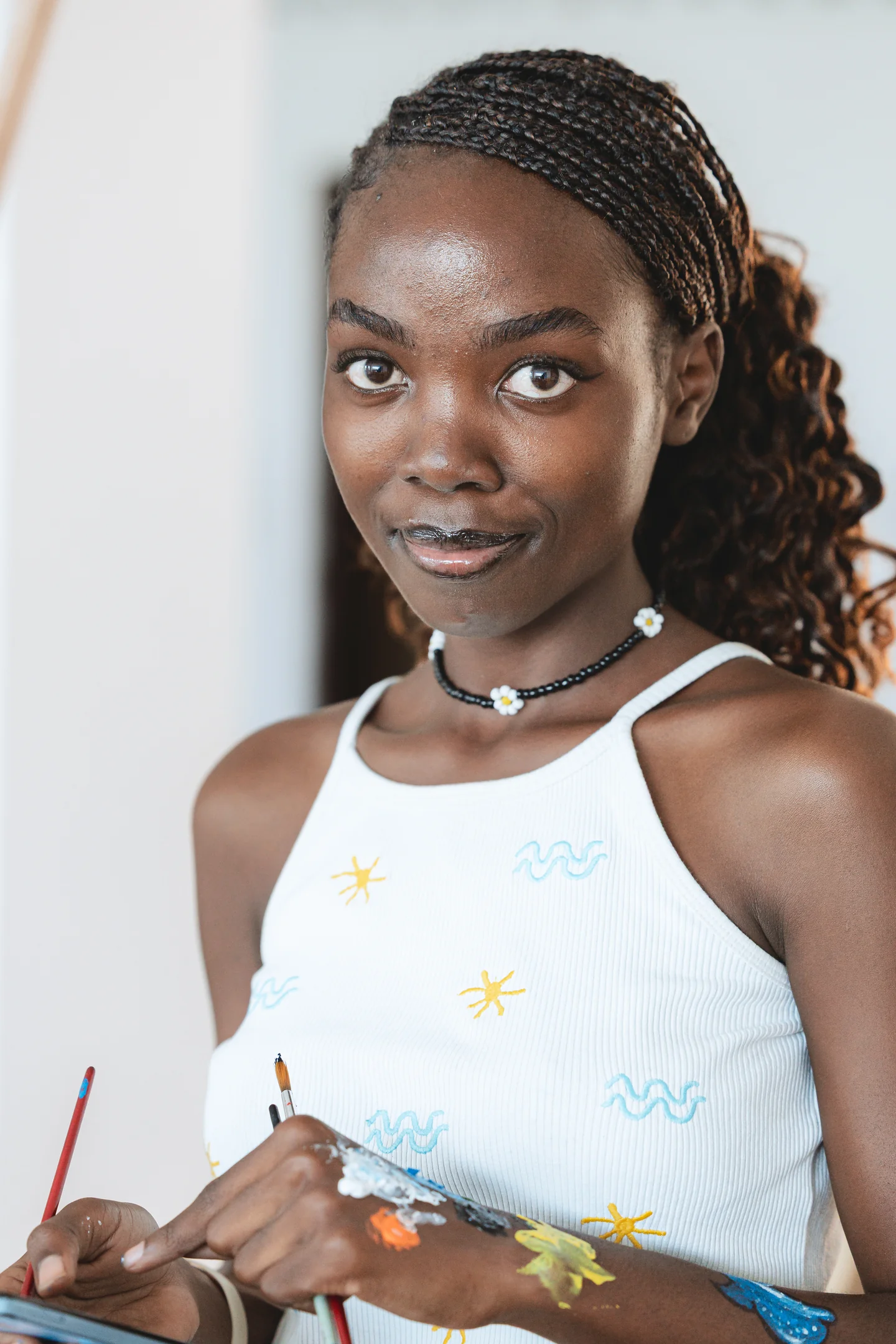
Everyone
The man in the chair is still under her brushes.
“Art is therapy. It’s the easiest way to escape reality.”
In 2019 the World Health Organization’s European office mapped the research on the arts and health, more than 3,000 studies, and found a role for the arts in preventing illness and in managing and treating it. It read the literature in English and Russian, with a focus on Europe.
“And everyone is an artist, actually. It’s just that you refuse to venture into it.”
Sanara is a Mastercard Foundation programme delivered in partnership with HEVA Fund, SNDBX-Ubuntu, Baraza Media Lab and GoDown Arts Centre.