
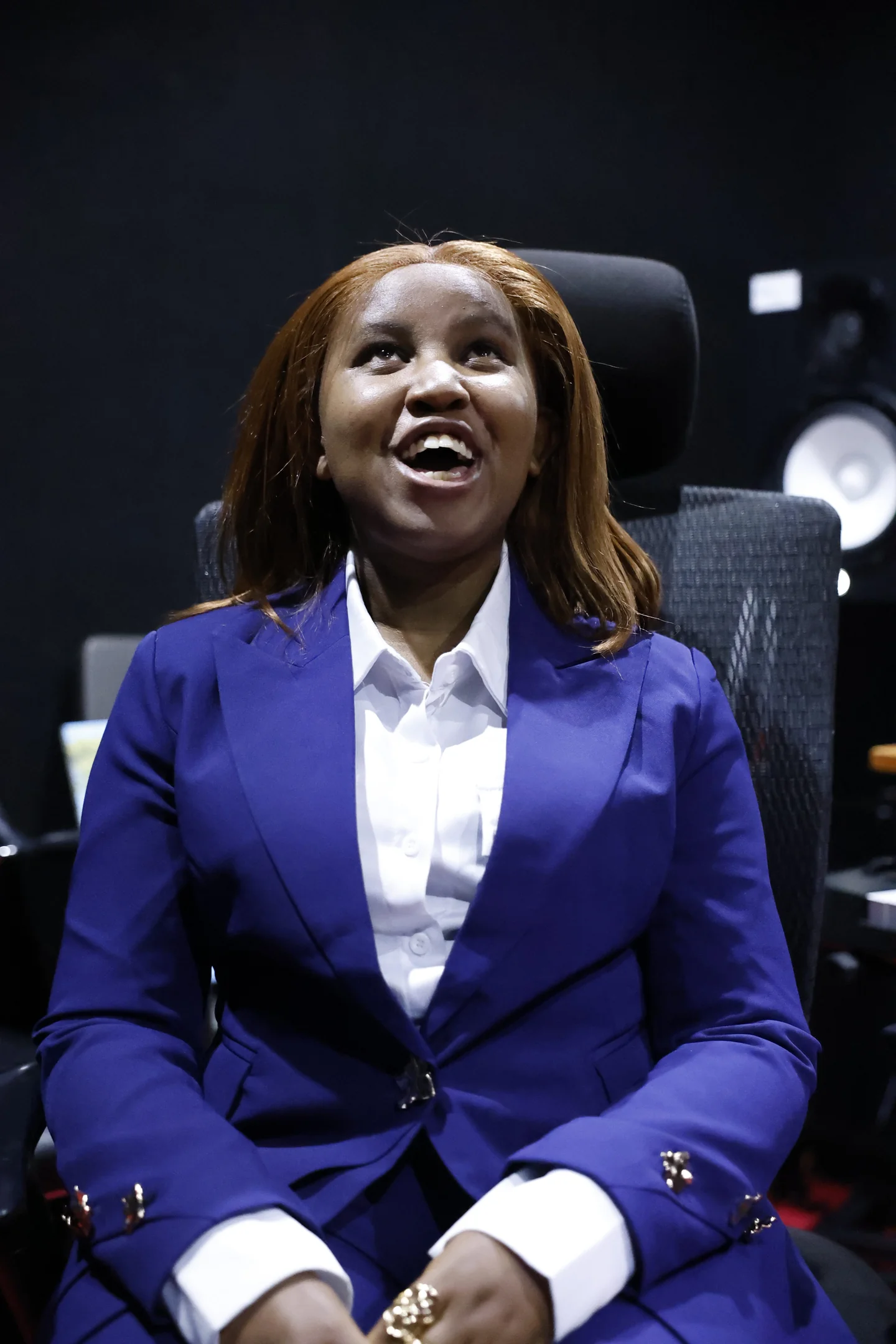
“I take my time to school them. Whatever you ask, I’ll just answer.”
The studio at the Kenya Society for the Blind in Nairobi is loud before it's quiet. It's late August 2026, and the Pearls Band are at the microphones working through a Kiswahili song they call “Taxi Driver,” Jacinta Wambua among them. The producer wants everyone at once, and somebody insists they sing it for real, because miming boxes you in. The tune is still in the room after they stop, and she says she needs to play it once or twice more.
She's a special needs educator, a disability mainstreaming advocate, a singer-songwriter and a podcaster, and she's used to being asked things. Most of the questions are the same few. She's heard them enough to quote them.
“Oh, so you can sing.”
“I feel for me, music has been something that I’ve done. So it was people realising, ‘Oh, so you can sing.’ Music for me has been a day one.”
“I just realised I could sing, and I didn’t know how to live without singing.”
She was about nine the first time she competed. She thinks she was the one who started solo set pieces at her primary school - you get a solo, you train, you go to the galas - and later she went to school for music. And for a long time she wanted to stay behind the sound.
“I wanted to be an anonymous artist. I wanted to be a ghost singer. I think it was because it was an imposter thing.”
The first paid job arrived in a single day. A friend rang one morning: a Rotary installation needed a musician. “We want you. We are looking for a musician. Can you come?” By the afternoon she'd found a keyboardist, and they went and played. The fee was more than she'd thought anyone would pay for a voice. She keeps the figure. “That’s how much we’re talking.”
“Who records for you?”
She and two friends started a podcast because, as she puts it, they're yappers. They talk about what she calls the unconventional things in the world of disability: dating, partying, domestic violence as disabled people live them.
The reactions run to curiosity. “Pia watu wenye hawaoni huwa wana podcast?” Then the practical one.
“We have a team.”
“Podcasting is just a matter of, do you have things to talk about? Can you talk about them?”
And there's the question everyone wants asked, about the dating. Jacinta akona mtu?
“Hata mi najiuliza, Jacinta akona mtu kweli?”
“You don’t even look blind.”
That one came at a modelling competition.
“So, okay, how do blind people look? Or like, what is it that should have sold me out to be visually impaired?”
It doesn't shock her any more. “Having been blind for some time now, you know what to expect from people who have not encountered persons with a visual impairment.”
“Sometimes you will want to just live your life, and people will be, ‘Na sasa haoni.’ And you’re like, ‘Oh, thanks for the reminder.’”
“There’s so much to life. There’s so much to live for. There’s so much that can be done regardless.”
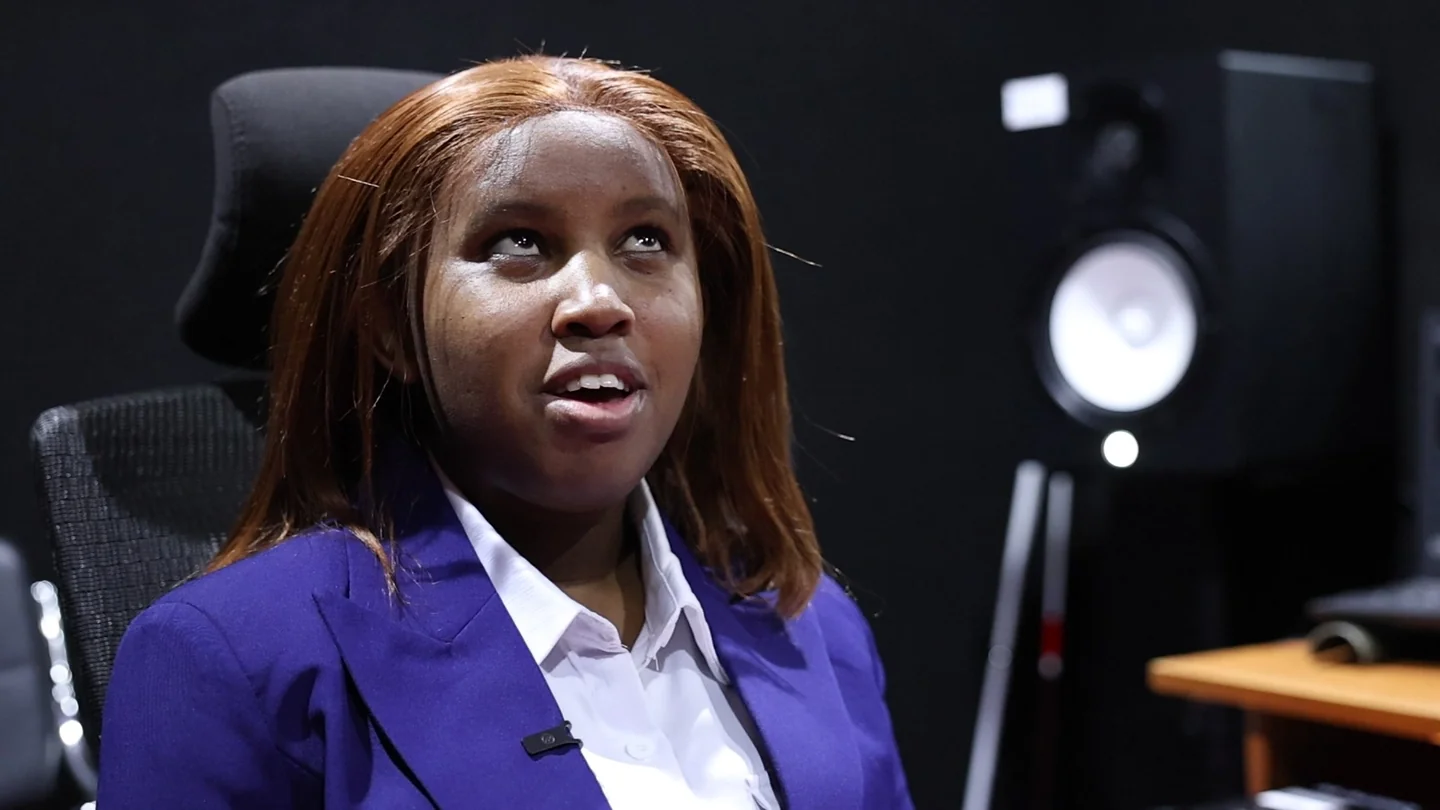
“Music, then what?”
This is the one she put to herself, before a friend called about auditions at KSB for Sanara's music training. “He signed me up. So I was called, we came, auditioned, and then they picked us for training. It was that easy.”
“I wouldn’t say I learned to sing here. I have always sung. So it was pretty much the confidence, and wanting to tap into music, ’cause it had come to a point where I’m just like, okay, music, then what?”
What came back was paperwork and effort. “You need to put in work. You need to get your things registered. The business aspect of it is what I think I benefited a little from here.”
The band came from the room. Some of the trainees had been her friends before the course, and they sounded right together. “Let’s try to kill time while at it. Form a band. Easy. We had the instrumentalist, we had vocals, and we had ideas.” They got a platform at KSB, then gigs, then recordings, and now they get invited. When an event is too corporate for a band, or it's an evening karaoke session, she goes alone.
“I am a better live performer, because I feel like it’s only when I’m doing live performances I come alive with my singing, and even then people get to enjoy everything unfiltered.”
“I don’t want to go to the studio and record for people to reference to. If I have an option, I just want to do corporate live performances and maybe private events, and just go home.”
The band is building a repertoire for Christmas: a set list, a portfolio, then the calls to the people who book December. “We’re identifying ourselves. We’re looking at what we want to be known for.”
“Quality. Quality. If you’re calling me to your gig, know I’ll deliver. I will give you great music. I will give you good performance. It’s work, consistency, effort and delivery.”
“I won’t listen to someone and, just because I want to be motivational, lie to them that they can sing. As long as you have a voice, then you’re nurtured from there. At the end of the day, you want to put out decent art that people will listen to.”
“That was me, actually, a long time ago. With time, it grows in you. With time and when there’s money involved, the deal gets sweeter. If you’re doing it for fun, well and good. If you want to commercialise your art, then you have to show up, you have to be consistent, and you have to sing on.”
“Would you want to see?”
Take away the barriers, she says, and let people “explore, let you make mistakes, let you learn, let you in spaces where decisions are made.”
“Are you being heard? Are you being seen? Is what you’re saying being looked into?”
“Instead of trying to fix a person, or trying to ask people to pray for people, or even just asking, would you want to see? The world does not revolve around the things that you can see, and the sooner people make peace with that, the better.”
She's grateful for the rule that projects without people with disabilities in them don't get funded. “Kama hamna watu wa special needs, kama project yetu si inclusive, then haitakuwa funded. People might not know how much that means, but it is how inclusion is done. It’s how people feel seen.”
“I want to be part of the process. Many a time, decisions are made for people, and at the end of the day some things don’t work, and you start adjusting. So to avoid all that, involve creatives, especially creatives with disabilities and impairments, at negotiating tables, where decisions are being made, even where there are funds.”
“’Cause how you think you’d want to fund me might be different from the type of funding I want.”
The Creative Economy Support Bill, as the Senate first published it in 2024, would create a guild to advise government on policy for creatives, and its own digest says the guild would represent the interests of women, young people and people with disabilities in the industry. The bill hasn't become law. She thanks the people who've backed them so far, “even as we await our funding.”
“So what?”
“I am blind, so what? Honestly, I am blind, so what? I will make decisions. I will face the consequences of the decisions I’ve made, regardless. Blind or not, I would have still sung.”
Sanara is a Mastercard Foundation programme delivered in partnership with HEVA Fund, SNDBX-Ubuntu, Baraza Media Lab and GoDown Arts Centre.