
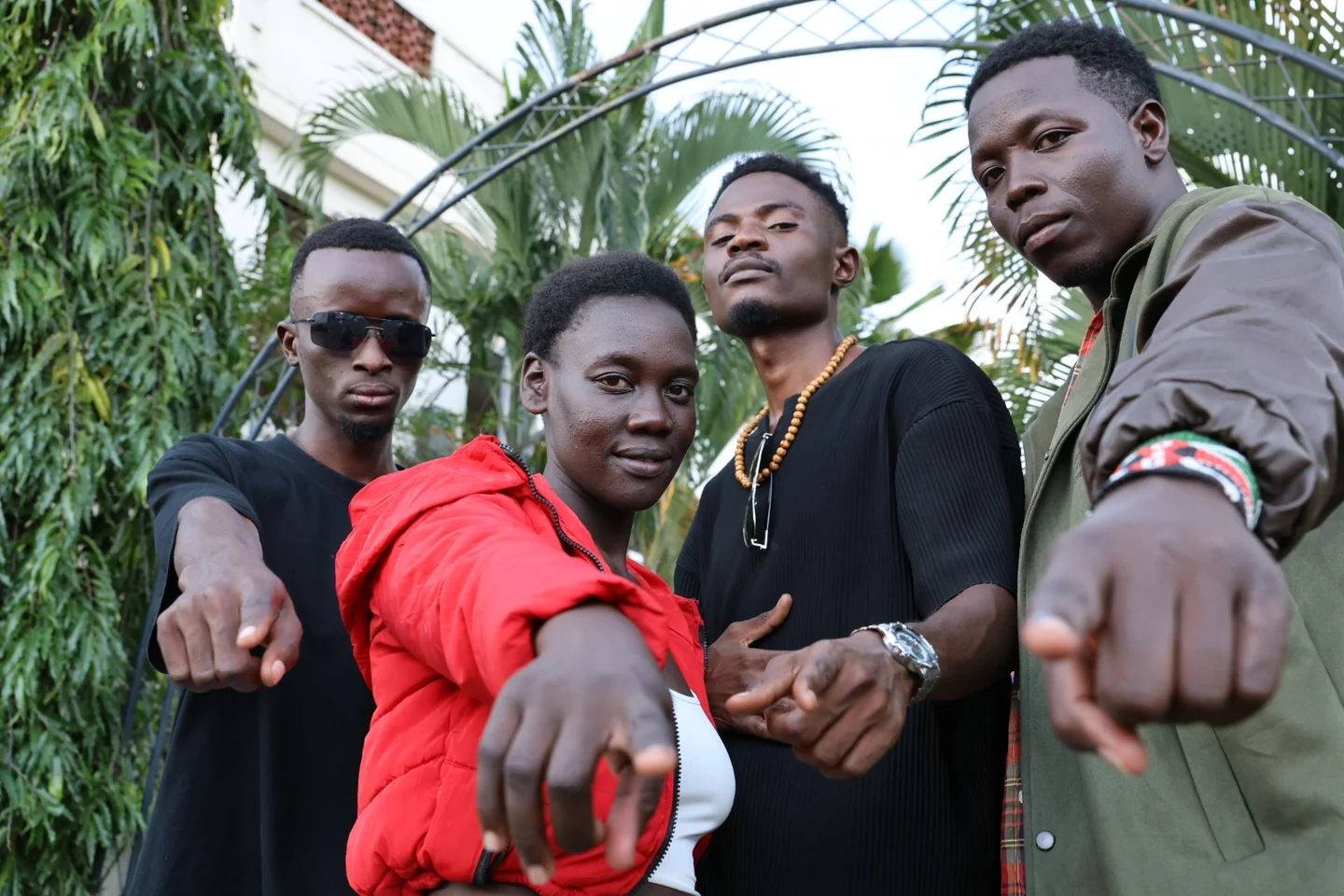
“Tusingekuja hapa, hatungejua those songs are being registered without us knowing, without our consent.”
The four of them had gone to register one of their own songs. It was already registered, to somebody else.
“Because the person paid for the studio, ana-own the song. Na ni sisi ndio tumeandika, tukasing.”
They’re the Songbirds, from Kisumu, and on 12 June 2025 they’re standing outside a white building with red columns, talking over each other. A sentence starts with one of them and is finished by another. When they introduce themselves, it comes out as one sweep.
“I go by the name Brayz, B-R-A-Y-Z.”
“I go by the name Barry B.”
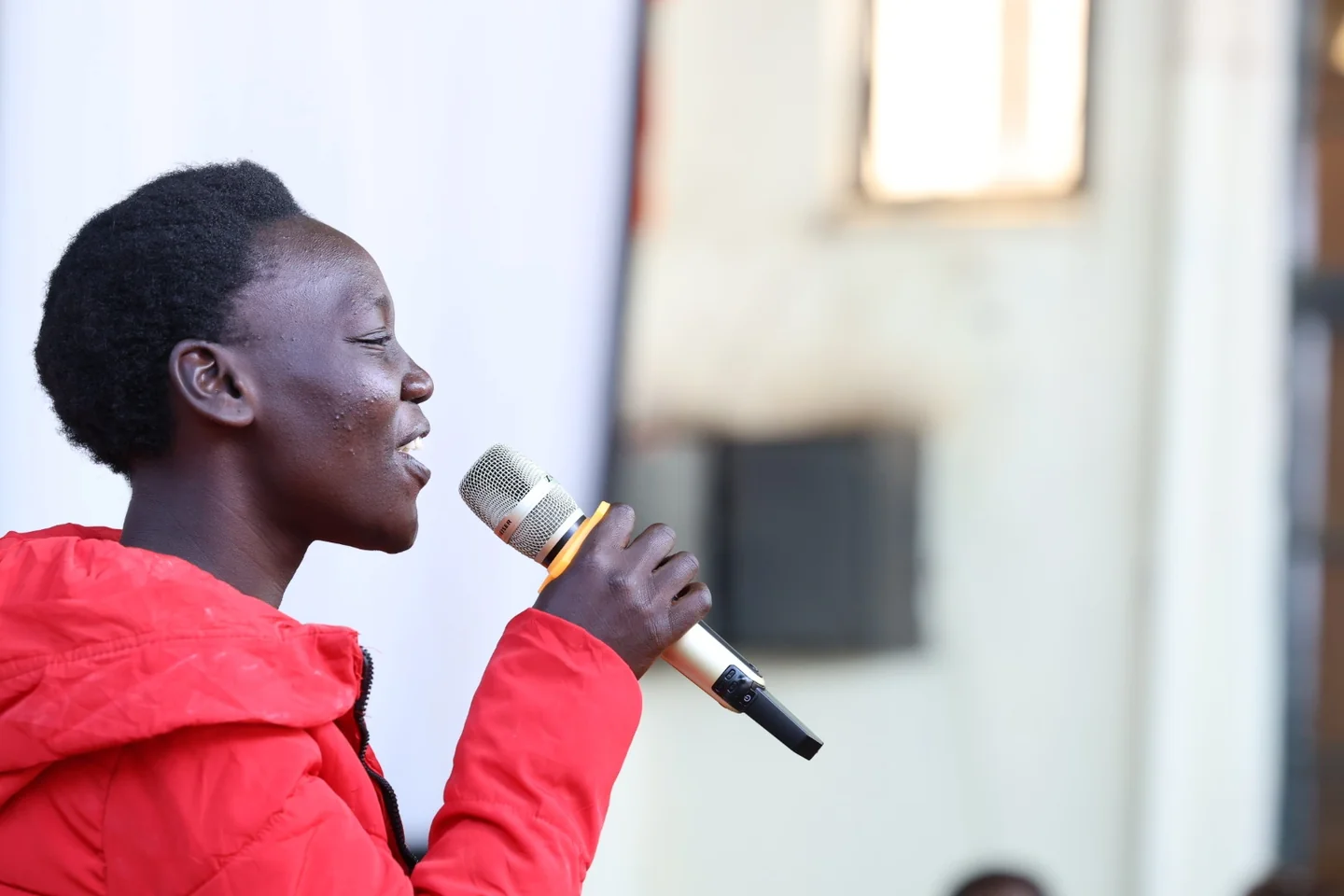
“And I am Jalvia.”
“I go by the name Stephen. With a PH.”
“And together, we are the Songbirds.”
Afro-fusion and pop, they say, though they won’t be held to it. Love songs, and the other kind. “We also do conscious music.”
Now we are one
“We met in weird ways.” Barry saw Brayz perform at a music event and liked how he did his thing, and Brayz liked his. “Our aim was to collaborate,” Brayz says. “But now we are one.”
Stephen and Brayz go back to Class One at the same school. Stephen was the friend in the crowd, then the one writing, then, without quite deciding it, a singer too.
Jalvia came last. Someone heard her on a stage and offered to connect her with people who sang well. “So I was the last one. As you can see, I’m the only girl.”
Each of them had been a solo act, and becoming a group meant putting their own songs down.
“Tulianza kuandika ngoma from the grassroot. Tunasahau zile individual songs zetu, tunafocus kwa group, which ilikuwa challenge. Na pia bonding. We had to bond ndio hata tukiimba song inasynchronize, kuna chemistry. Hiyo bonding pia ilitake long time.”
And everyone has a life beside it. “Unapiga job, unapiga job.”
One of them didn’t perform at all before this. “Mimi nilikuwa tu kwa bafu na kwa nyumba. Nilikuwa na stage fright ingine noma. I didn’t even know how to look at a person nikiimba. These people wamenitoa, wakaninurture. Na sasa mimi ndio huyu sasa.”
They point at one of their own who paid for it out of his own pocket. “Huyu ametoa mpaka pesa kwa mfuko yake ndio tufike shows.”
The physics book
The member in black, wooden beads at his throat, starts this one himself. “It’s a very long story. A funny story.”
It was the run-up to national exams. He’d show up at school and slip out of the back of the class to make music, and the register kept marking him absent. On the day of the parents’ meeting, a Cruiser pulled into the compound. He assumed it was about somebody else. Some of the boys at that school came from rough places, he says, so you expected anything.
It was about him.
“Wakakuja na huyo chief, wakaingia class, wakaita jina yangu. Nikachukuliwa nikapelekwa kwa chief, nikapigwa viboko, nikarudi.”
A month later he dropped physics.
“Buku yangu ya physics niligeuza ni-write music book. Niliona physics haingii. So instead ya ku-waste hiyo book, wacha nifanye nayo music.”
A musician he worked with was a year ahead of him and had already left school. He’d see that friend’s name on posters while he sat in class. He doesn’t recommend his own route, and he respects his mother’s insistence that he finish first. “Usipe muziki 100%, then uwache shule ikae chini.”
“Balance,” someone says.
School turned out to be useful for the songs anyway. “Huwezi andika tu mstari kali from nowhere, from mtaa.” Grammar. Rhyme. Stylistic devices.
Iko na do
Does music pay? Two answers come at once.
“Muziki iko na do. A lot of money. But inategemea how have you packaged yourself. If you package yourself well, uko na rate card, and you have all this stuff.”
“Ukweli ni bahati.”
“Eh?”
“Ukweli ni bahati yako, na venye unajipush.”
“Bahati pia. Bahati ya mwenzio huwezi lalia.”
“Muziki iko na do, lakini hiyo do haitafikia kila mtu.”
Neither side gives way. They talk distribution sites instead of posting to YouTube and waiting, TikTok challenges, the one-hit wonder with a big name and nothing after it.
“Music haina do, but music business iko na do.”
Sanara takes its name from the same split, sanaa and biashara. When the programme gathered its partners in Nairobi in July 2026, a year after this conversation, it reported more than 20,000 young creatives trained and more than 330 creative enterprises financed across its six counties. Demand for Ota, the creative loan HEVA Fund runs under the programme, had reached nearly four billion shillings.
Jela
The Sanara business classes, run in Kisumu by SNDBX-Ubuntu, cover marketing, finance, tax and legal compliance.
“Tulikuwa wafungwa. Tulikuwa kwa jela.”
“Jela gani?”
“We were in a CBO, na tuliweka mind yetu kwa CBO tukijua hiyo ndio bridge yetu. Hiyo ndio daraja, eh? We gave our all. But after kuja through this lesson, tulijua tunatumiwa vibaya.”
They describe what it looked like from inside. Somebody lends you clothes to wear on stage, takes you to perform, gets paid, and keeps it. “Yeye hatoi hata 10 bob. It’s like songs ni zake, si zetu.” Somebody pays for your studio time and your video, with no agreement. “Unaskika Nairobi, unaskika Eldy. Inasonga, but mfuko hazi.”
“Wewe unajua uko na Mungu ameshuka anakuja kusaidia,” one of them says. “Kumbe anakutumia.”
They left, and started managing themselves. Then they tried to register their songs, and found the first one already taken.
The classes came, another says, just as they were already in it. “So you start questioning whatever you have been doing.”
“Are we doing it the right way?”
“Are we legal?”
One of them changed how he works. He used to record and then wait for his moment. “Nilichange my strategy, nikuje na plan zingine, na sisi pia tukachange. Now we work like adults. We work as adults, legally.”
“Big up to Sanara program. Wametusaidia sana as creatives who are, I can’t say we are upcoming, but we are growing. Hakunanga mtu upcoming. Kama wewe ni upcoming, wewe bado uko kwa tumbo, bado hujazaliwa. Juu ukizaliwa unaanza tu kuimba huko kwa labour ward.”
Still sailing
What keeps them in it is partly spite. Somebody told them they’d never make it. “So I always want to prove him wrong, na anajijua. Hiyo kitu aliniambia, aliwasha moto in me.” Partly it’s the people watching from where they come from. “I come from a ghetto where watu believe from ghetto huwezi make. If I give up, I’ll be the lesson to them that muziki haiwezi.”
Advice goes round the four of them.
“I would start with a harsh one. A truth. However much you push your music, you are not guaranteed to be successful. But what matters is the experience you gain from the journey.”
“Ukienda solo, you’ll move fast. But ukienda na team, utaenda far sana.”
“Practice makes progress every day.”
The last of them goes slowly.
“Kuwa na roho ngumu na ujiamini. Be bold. Stick to doing things that are right, na uendelee na the right road mpaka siku yenye utafika.”
“Na utafika.”
They’ve been a group for nearly two years. Most of them have been in other groups that didn’t last.
“We’re not breaking up. We are still sailing.”
Sanara is a Mastercard Foundation programme delivered in partnership with HEVA Fund, SNDBX-Ubuntu, Baraza Media Lab and GoDown Arts Centre.