
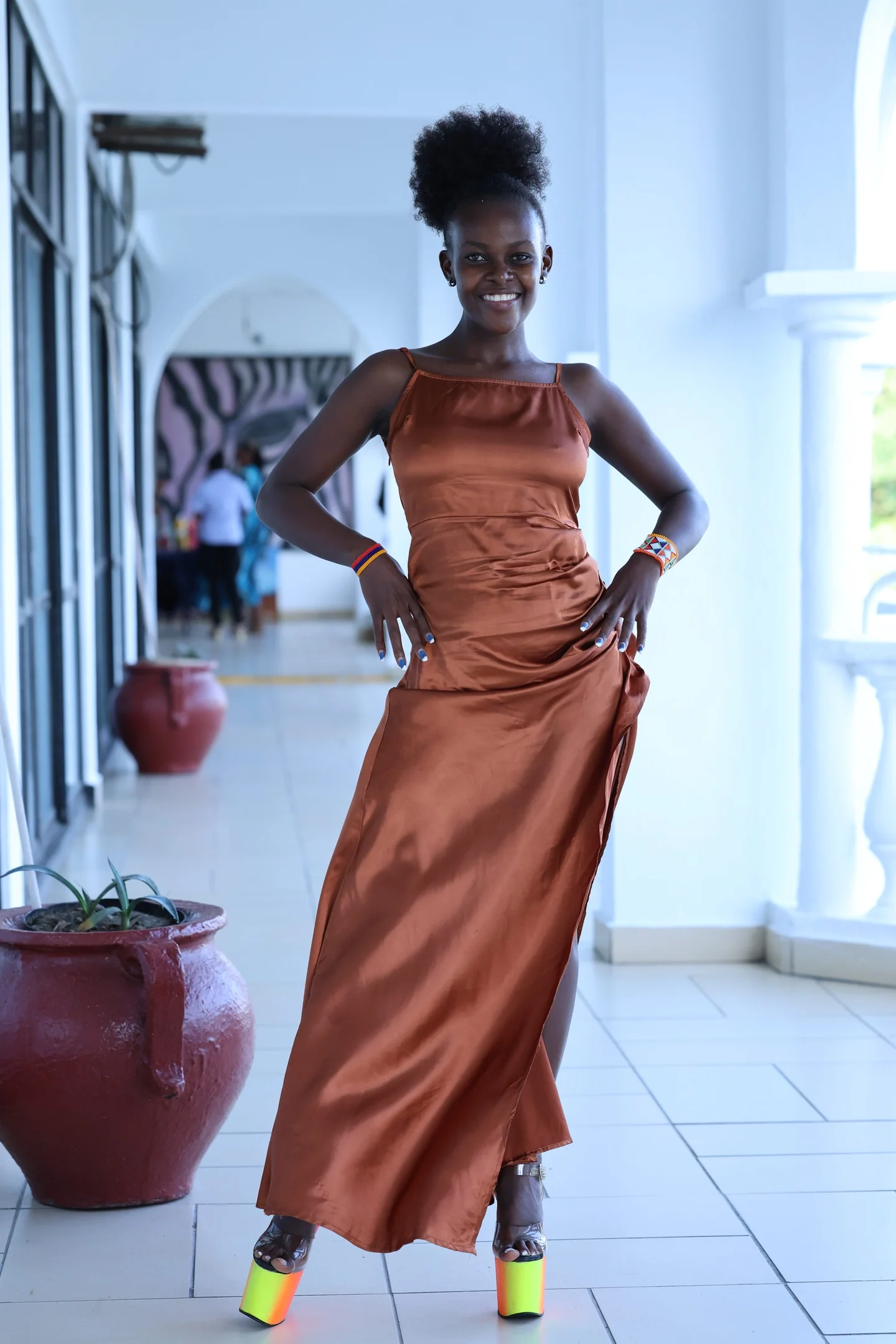
“Every time she went for training, she’d say, ‘Madi, come we go.’ And every time, I was the one who used to take videos of her.”
Before she modelled, Madelynn Nafula held the phone. Her friend walked; she filmed. Somewhere in the filming she started doing a sum.
“I felt like, if she can do it, how will I fail to do it?”
On 20 June 2025 she’s at a Sanara graduation in Mombasa, her own. She is 25, a model, and a graduate in medical engineering. The two don’t trouble her. “I believe in beauty with brains.”
She came to the programme the way she came to modelling, through a friend. “She called me and told me, you can come and showcase your modelling as your creativity. And I was like, why not?”
A sack
“Growing up, I was a very shy, let me say timid girl.”
“I always felt like an outsider. In every class, in every organisation, in every club. I was looking for a way out of that bubble of feeling like an outsider. And modelling was my way out.”
As a girl she made clothes for her dolls. Later, watching models, she made one for herself.
“My first dress was a sack.”
In her first year at university she tried. She went with her friend to a training, this time not to film.
“The first day I went, my first trainer chased me away and told me I don’t know how to model. And I felt bad. But I didn’t give up. I went back again and again.”
The moment it settled was watching that same friend win Miss Technical University of Mombasa, the title the university crowns each year at its cultural week.
“I was like, I need that spotlight.”
At home, nobody needs convincing. Her family push. “They are the ones who tell me, oh, kwani hauna event? Kwani what are you doing? Mbona hutuambii pesa ya nguo?” She calls them “the backbone of my modelling career.”
For now
She graduated in engineering in 2024. The engineering hasn’t come.
“I have not had a chance to work with medical engineers. Sijapata kazi ya kukuwa engineer for now.”
Modelling filled the space. She’s collaborated with EM Africa, a model and talent academy with branches in Nairobi, Mombasa and Diani, running trainings for it and going into schools around Mombasa, Diani and Kilifi to train modelling clubs.
“After school, modelling has paid my rent, modelling has bought me food, modelling has given me everything I need.”
Kenya created 822,100 jobs in 2025, according to the national statistics bureau’s Economic Survey 2026, and 87.2 per cent of them were in the informal sector. Wage employment, the kind with a payslip, grew by 3.1 per cent, to 3.3 million people in a country of more than 50 million.
She knows modelling has a clock on it, at least the runway kind. “In modelling, we age out mostly at 28. So before I get to 28, I should be having something else.”
That isn’t a plan to leave. “I can be an event organiser. I can be a trainer. I can create clubs and do charities as a model. Not as a runway model, but as a model.”
Wronged
The Sanara training left her with three things.
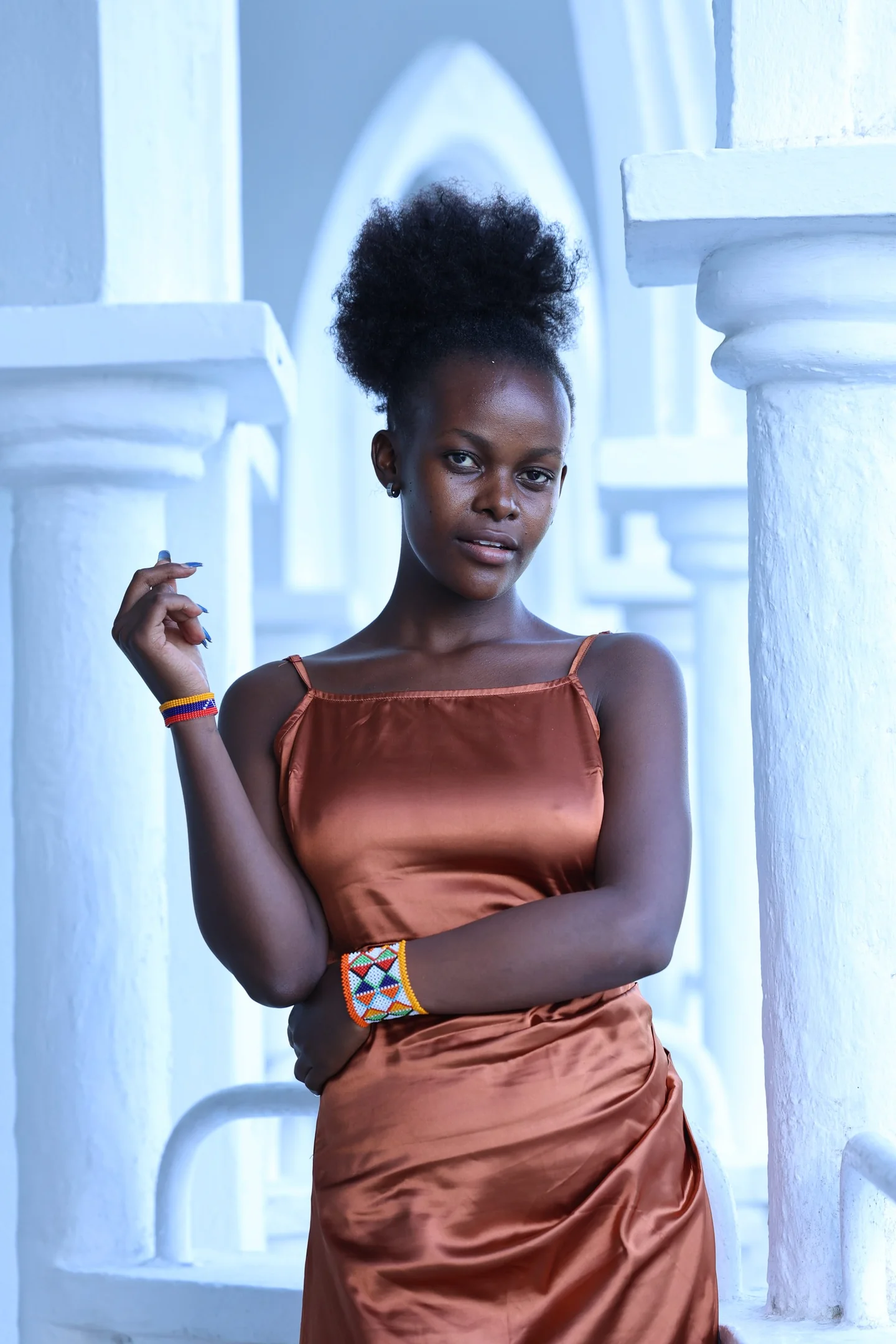
“I know my rights as a creative. I know when to sign a contract and when not to sign a contract. And I know how to market myself.”
Has she been wronged before?
“A lot. Nimefanyiwa mbaya mingi.”
“You don’t come into modelling kama hujiwezi kiroho. There are so many people who take advantage of models, especially event organisers. Sometimes they don’t pay you the exact agreed amount. Sometimes the grand prize is not what you were promised, or your term is terminated when hujamaliza reign yako.”
The most recent time was a high-fashion show in Mombasa. The organiser handed out contracts after the audition, and the models signed. To get onto the runway, each of them had to sell tickets first.
“Over 10 tickets, and one ticket is 500. And you’ve sold over 5,000 shillings, then you’re given 1,500 as payment.”
The money in the contract wasn’t the money they were paid.
“Because we only had the contract, we didn’t have a lawyer, or we didn’t know that we were supposed to take action. So it was that bad for us who had invested in that event.”
“It is not fair.”
In February 2018 a Kenyan model, Sheila Kanini, started a hashtag, #PayModelsKe, naming agencies, magazines and brands she said hadn’t paid. The pattern it described was familiar: portfolio fees taken up front, adverts run, models paid in pieces or not at all.
The day before Madelynn’s graduation, New York’s Fashion Workers Act came into force, the first law in the United States to give models protections of their own. Model management companies there must now give a model the total pay for a job in writing before the work starts, pay within 45 days, and stop charging signing fees. The Model Alliance, which campaigned for it, calls New York the centre of the industry in the United States.
Kenya has no law written for models. The Employment Act covers people on a contract of service, and a model booked for one show is usually an independent contractor. A Creative Economy Support Bill, which would set up a register of creatives and let the Cabinet Secretary make rules on labour issues with independent contractors in the industry, passed the Senate in August 2025 and hasn’t yet become law. What Madelynn has instead is what she learned in a classroom: when to sign, and when not to.
Go and model
There’s a girl somewhere who wants to model. “You need to follow your dreams.”
Then, half to herself, she realises where she’s got to.
“Hata sikujua ningekuja huku. Honestly, sikujua ningefika this far.”
Back to the girl.
“If you want to model, go and model. There are good people out there. And you never know who’s watching.”
“Haimaanishi you’ll go through what I went through. Inamaanisha you don’t have the same fate that I had. Your destiny is different from mine.”
“So go and model. Modelling is very fun. It is beautiful. Imagine wearing beautiful clothes.”
Sanara is a Mastercard Foundation programme delivered in partnership with HEVA Fund, SNDBX-Ubuntu, Baraza Media Lab and GoDown Arts Centre.