
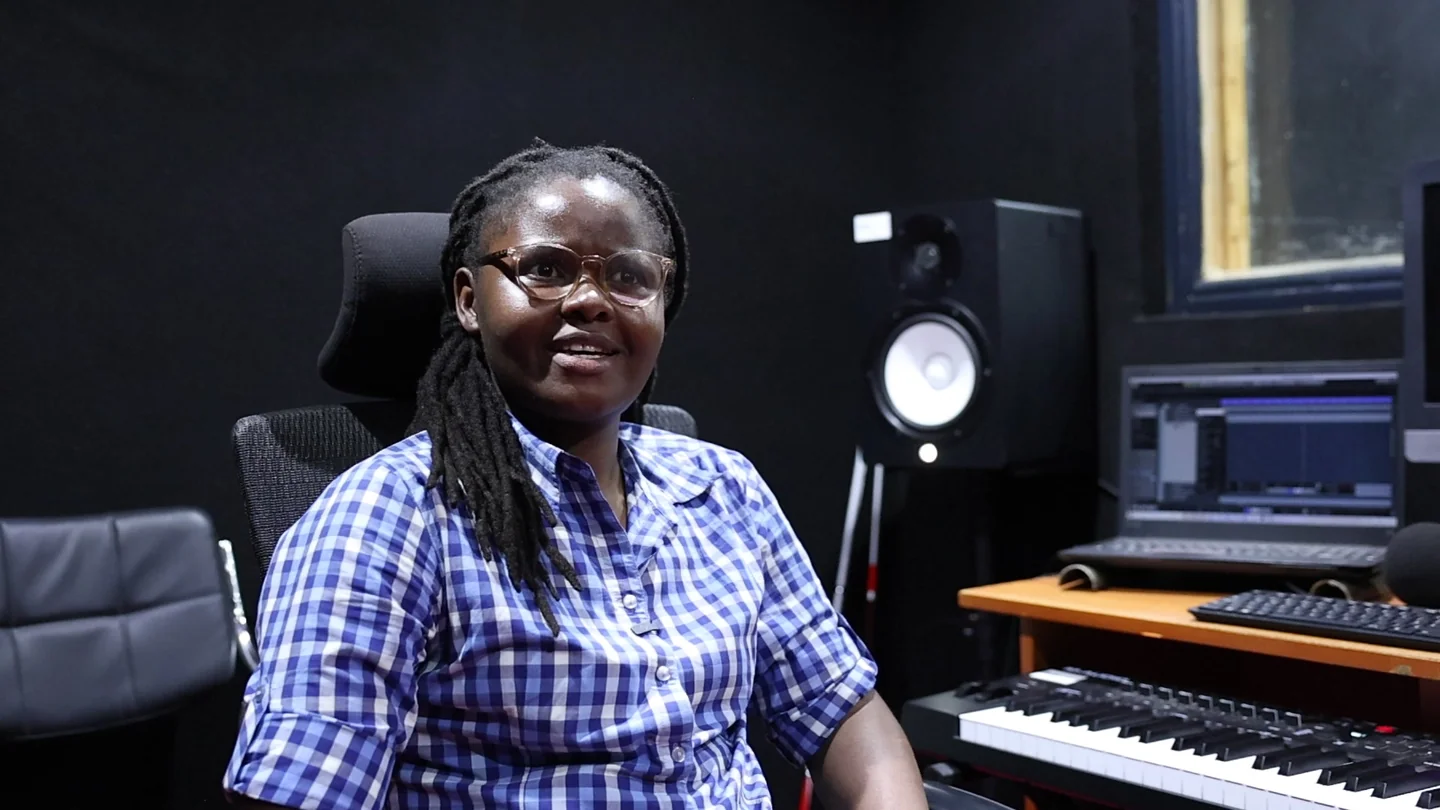
“I am Marion Akoth Adera. I am an athlete. I am an upcoming musician, courtesy of the Sanara Project. I am beautiful.”
The gym
“Growing up, I’ve always been fascinated by gymnastic activities, being in the gym, yet I didn’t know that it was a sport until late 2024.”
“It’s something that I’ve been doing with passion. I just love doing the gym things. So finding out that it was a sport, I jumped right into it.”
Within a year she was competing for Kenya abroad.
“In Kazakhstan, I had three silver medals. In Turkey, I had two bronze medals.”
The trips she names line up with Kenya’s first seasons in international powerlifting for blind and partially sighted athletes. In May 2025, Kenya’s visually impaired team made its debut at the IBSA Powerlifting and Bench Press World Cup in Almaty, and its women took four silvers on the first day. At the end of October, the team was in Mersin, Turkey, for the IBSA world championship. Its organisers used the occasion to press a point: powerlifting for blind athletes still isn’t on the Paralympic programme.
This year there’s been no travel. “We are hoping for the best, because the year bado haijaisha.”
The studio
“To clarify, I was not born blind. I’m somebody who acquired blindness in late 2022.”
She’d sung in the music club at primary and secondary school. After that, “somehow I was carried away with life, vile inakuanga, and then kidogo kidogo I lost my sight.” She came to the Kenya Society for the Blind for rehabilitation, to learn the rules of what she calls “this other world”, and “to know how to cope up with this new life”. She finished, and left.
Then Sanara set up its music training at KSB, and the people there remembered her.
“Being that I was an all-round student, I would say so, they contacted me to ask if I was interested, and then I had to come back for that.”
She came for the music and not the money. “I didn’t focus on the economic side of it. I was just there to enjoy music.” Sanara, for its part, set out to reach 5,500 young people with disabilities across its six counties between 2024 and 2027. It hasn’t published how many it has reached so far.
She auditioned and got through, and the people who got through with her became a band.
“It has been pure bliss, if I can say so. It’s more of a therapy than the real therapy out there.”
The money she hadn’t come for arrived anyway. “To top it all, the fact that I could gain something from it, like economically, something that I did not think, it’s good.”
How much is another matter.
“That’s a story for another day. It’s not yet out. It’s cooking. Iko kwa jikoni, let me say so.”
At the door
After the training comes knocking on doors.
“Unaenda tu kugonga gonga, because nobody believes in you. First of all, I haven’t created a name that watu watajua so and so is a musician out there. So you’re trying to go to these spaces, trying to get contracts.”
“The first thing they see is your disability. The fact that you are there with a white cane. So whatever they think about you, inaishia hapo kwa hiyo white cane. They don’t go beyond that.”
“The perception that the world has towards the visually impaired. Some think that because you’re visually impaired, you’re dumb. There’s nothing good that can come out of you.”
“For me, I always say it’s about them, not me. So if they reject me, it’s okay. I’ll keep pushing, because you’ll not change the version that they have of you. And it’s not your business again. If they want to change their perspective, they will. If they don’t want to, you cannot force them.”
What others saw
“Sometimes you join something just for the sake of doing it, not knowing what is ahead of you, yet somebody might see something in you. Like for me, it was the people around me that kept pushing me, meaning they were seeing something in me that I could not see.”
“When somebody tells you, ‘you are this and this and this,’ take it seriously. For sure they are seeing something that you cannot see.”
There are blind singers out there with the voice who aren’t sure yet.
“It’s not that they have to throw the fear away. But they can let the fear sit at the back. Iwa tu, ingoje hapo, wao wakipush on.”
Sanara is a Mastercard Foundation programme delivered in partnership with HEVA Fund, SNDBX-Ubuntu, Baraza Media Lab and GoDown Arts Centre.