
“My name is Nadia, and I'm a professional DJ.”
“I've been loving it for the last five years.”
Nadia's Experience
On the Kikuyu Love Sessions YouTube channel her set is filed under the same plain heading as the others, NADIA THE DJ | Live Set | It's Her Turn Campaign. It doesn't begin plainly. A voice opens it - Welcome to Nadia's Experience - and then the music comes in and moves where she takes it, through Kikuyu and Kiswahili and English and, for a few bars, something in Spanish. Every so often the voice comes back to stamp the mix: Nadia the DJ, Miss Good Vibes. Somebody, somewhere along the way, shouts Oh, here we go.
What she wanted to understand, at the start, was the night.
“I used to love the nightlife. And I needed to know what drives this nightlife.”
She began during COVID, which in Kenya meant a dusk-to-dawn curfew from March 2020 until October 2021. So she studied it wherever it could be found: at the booths that were open, and then at home on YouTube, working out how the blends she'd heard were built.
“I was like, yeah, I think this is what I can do. And when I started it, I felt like I'm not wasting my time. I'm just loving what I'm doing. It's just flowing.”
Self-taught, mostly, though not alone. “It was a combination. More of YouTube, more of visiting where they practise, more of checking on what DJs do when they're on live sets. There are a lot of people who came through for me, especially DJs.”
Edward
Two of those people she names. A friend, Santos, introduced her to a man called Edward, who ran a nightclub.
“I can't forget about him.”
“So I told Edward, ‘I'm a DJ.’ And then he was like, ‘How long have you been DJing?’ ‘Only two weeks, but I can do my best.’ So he believed in me, and told me, ‘You just go and check. Take your time there, and let's see how it will go.’”
Two weeks. He gave her the booth anyway.
She hadn't thought of it as work. “At first, I didn't know that there was money involved. Because of the flow of the music and everything. When you DJ, there are dancers involved. There's something that is involved there.” Edward paid her, and the night she'd been studying turned out to have an economy inside it.
“That's when I saw, hmm, I'm earning. I can get money from here. There is bargaining. You can earn this, you can get this, and you can talk about it.”
A percentage
Most of what's said to her after a set runs one way. “Anytime I DJ, if it's a club, a ceremony, someone just tells me, you're meant for greatness. You can do better. I can get you a show.”
The rest she puts at a percentage - “10% or 5%” - and it's a percentage of people as well as of gigs. Some booked her and wanted it free. Some kept asking the question she was already asking herself.
“You really ask yourself, is it worth it? Because sometimes it really brings the spirit down. We can't be on the same page, and you still want me to just do gigs for free, or you want to take advantage, because I'm still young.”
“There's still a percentage that was telling me, is it worth all this hassle, all the dramas? But the other people who kept on pressing me gave me the energy to still continue. Especially my parents. They still pushed: what do you need, what do you want?”
“So I kept on. And here I am, still pushing.”
The word she reaches for is young. The campaign about to find her was called It's Her Turn.
Violet, and a page
She hadn't heard of it. A friend had.
“She inboxed me, and then she's like, ‘Nadia, you should try this. We are doing this. I don't know, but you're taking this home. I've attended Kikuyu Love Sessions, and I know you're meant for this.’”
“She's called Violet. I should give her flowers.”
The second message came from somewhere she still can't put a name to.
“There's also a page that forwarded it, Nyeri Nightlife. I don't know who is behind that page, but he or she believed in me.”
Nanyuki
She lives in Nanyuki, in Laikipia, a long road north of the capital. Once she was through to the final six, the meetings and the shoots were in Nairobi.
“At times I had to come from Nanyuki. There's a day we had to meet as a group. So everyone is from Nairobi, and I'm from Nanyuki, and I'm like, gosh, is it really this hard? I need to wake up early, attend meetings, shoots.”
“And then I said, yes, everyone is seeing my potential. Why am I not pushing it? So let me just do it.”
At the handover, SNDBX's speaker told the room where the programme's business training had been running: Turkana, Kisumu, Kakamega, Nakuru, Nairobi and Mombasa, some 2,500 creatives so far. Classes would reopen in January, the host added, and the finalists should find the county nearest to them.
Nadia the DJ
When it was her turn at the microphone at Baraza Media Lab, the MC stumbled over her name - “Nadia, no, I have to say it right” - and went back for it.
“Hi everyone. I don't know why I'm shy.”
She said she'd switch to Kiswahili, and mostly didn't.
“I'm not actually the one who saw it. It's my friend. She's called Violet, and she knows that I've been pushing. I've been pushing.”
“Everyone who has a brand here knows how getting that confidence, getting someone to believe in you, and getting someone to see your vision - it gets so hard. I had to come from Nanyuki. Behind the scenes, ni mingi, but I know it's all worth it.”
She thanked Kikuyu Love Sessions, HEVA and Sanara, and reached for a title for Allan Gitau, who'd run the campaign: “a destiny connector.” Leaving the microphone, she remembered one more thing - they'd recorded the mixes “without charging us anything, by the way”.
“We are not stopping here. We are going for everything that we've ever wanted.”
Every month she writes two lists. “These are the gigs I have. These are the equipment I need to push me to the level I'm not at yet.”
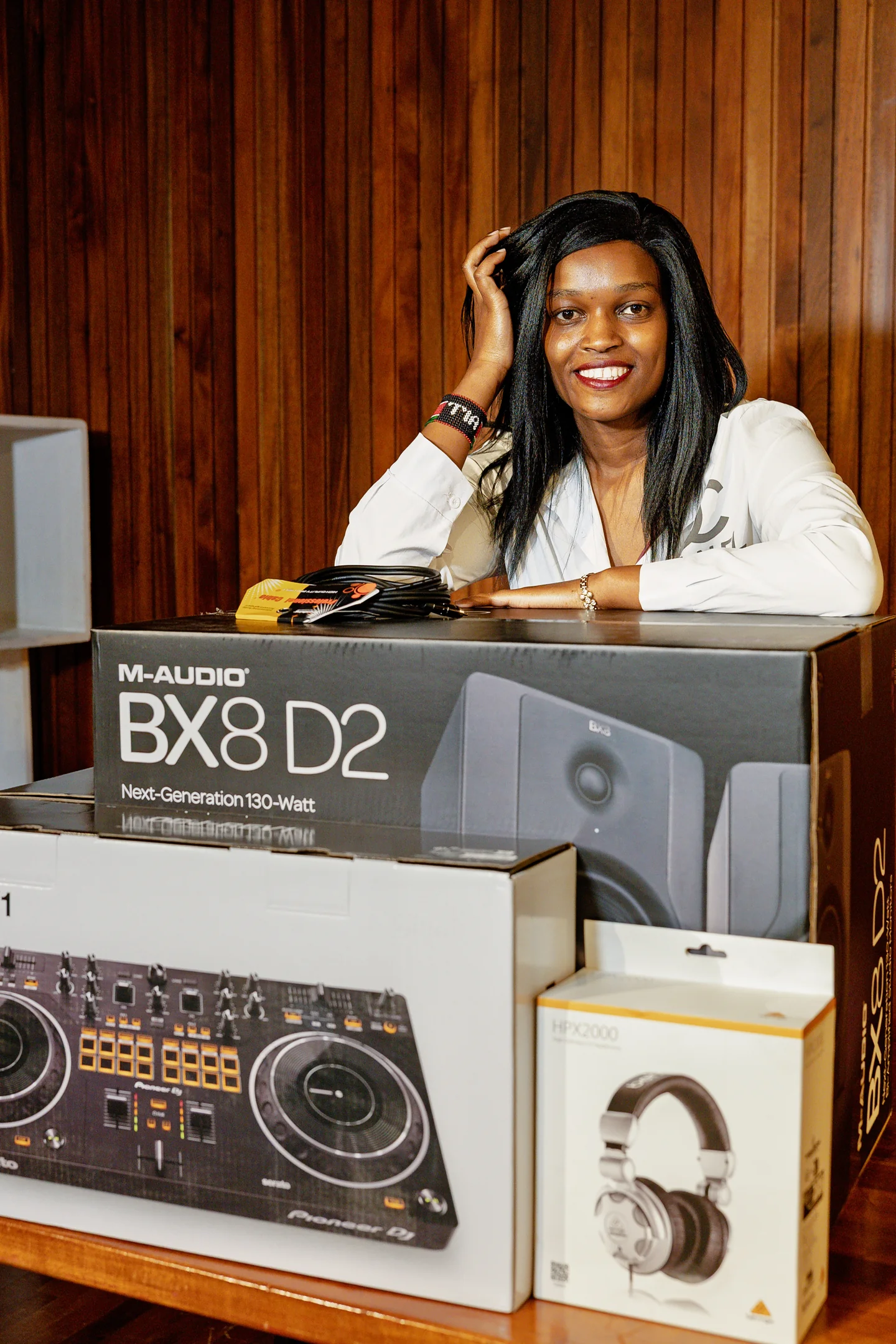
The kit, when it came, answered the second list. “Not even 80. The equipment I've been given, 100% of it, I needed it.” She'd been hiring, gig by gig, the equipment she used to make other people's nights. “Now imagine, I'm not hiring that again. I have the monitor speakers, meaning I can record from anywhere, if it's a YouTube video.”
“Imagine, what I've gotten is 90%. The only price I'm paying is 10%, and the 10% I can come back with. So I don't have any reason to say that I couldn't manage being a superstar. I'm already coming.”
“I think patience still. I'm learning not to be so hard on myself, and to be consistent. I think I lacked that.”
“Nadia is a brand, and it's coming. I'm the next big thing. I'm already a big thing, but we're going to the 100.”
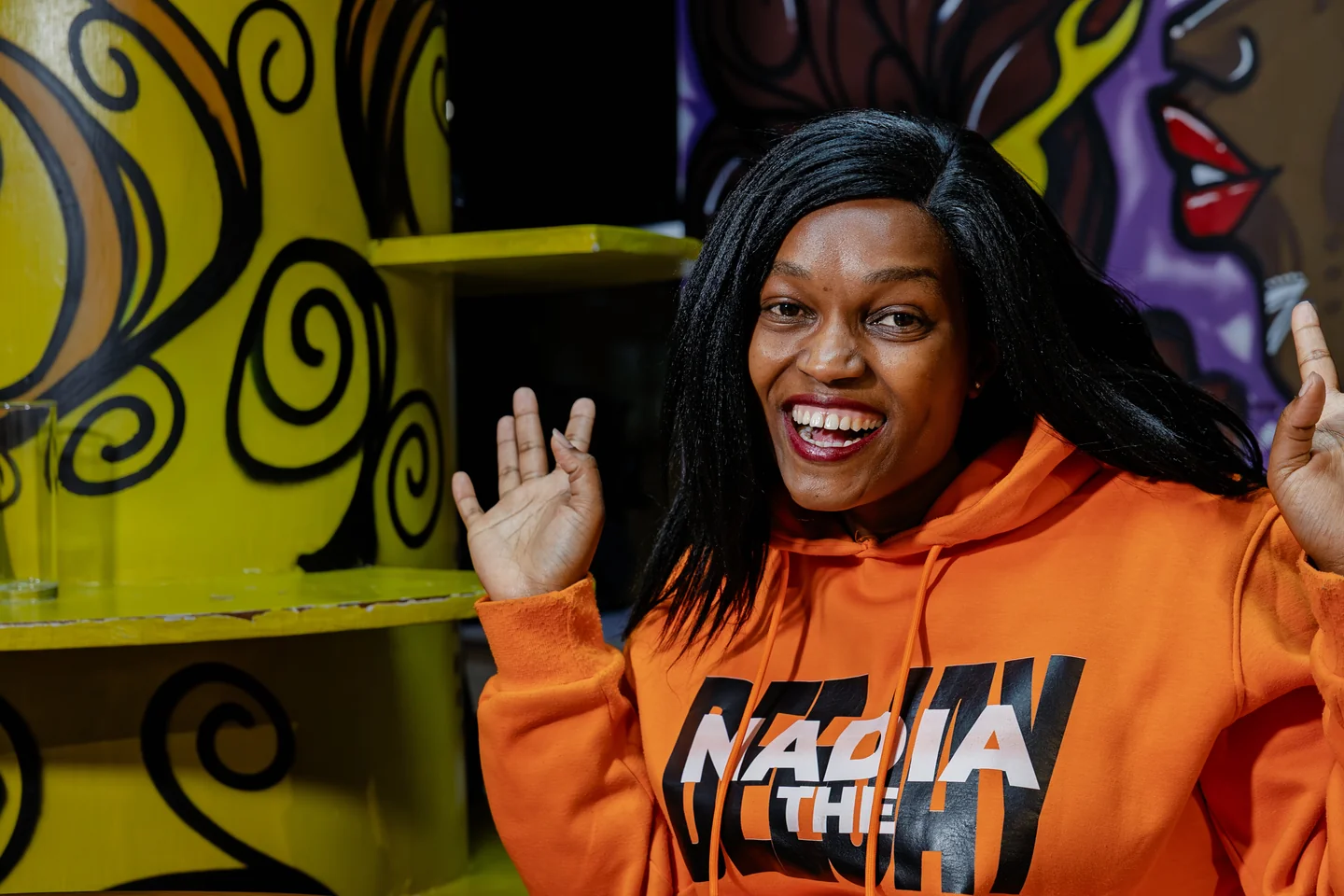
Afterwards she changed into an orange hoodie, her stage name printed across the chest, and stood against a mural of a woman's face crowned with flowers. She hid her face in both hands. She blew a kiss.
“You see, I can keep going.”
Sanara is a Mastercard Foundation programme delivered in partnership with HEVA Fund, SNDBX-Ubuntu, Baraza Media Lab and GoDown Arts Centre.