
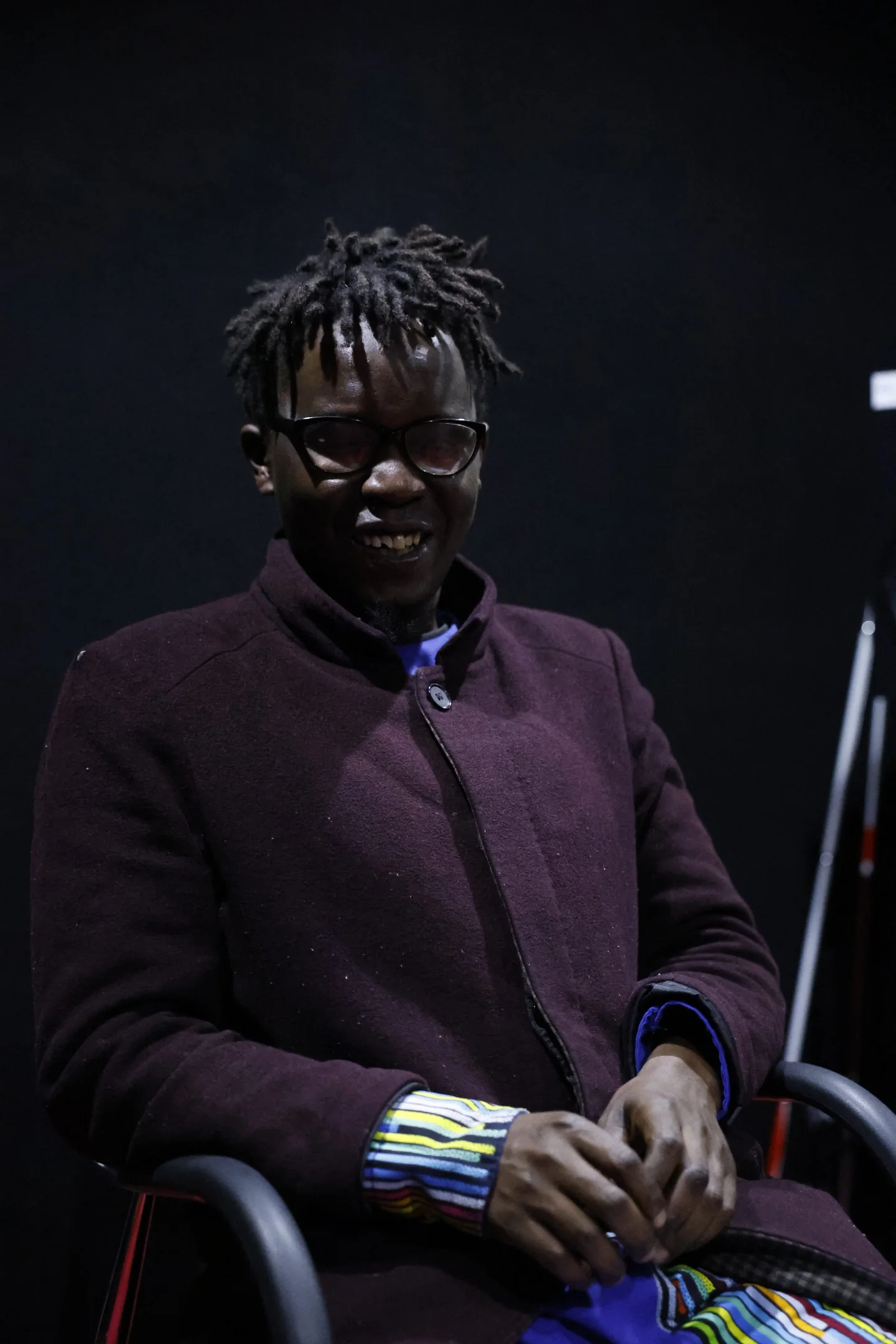
“I hear a song, ‘Ooh, I’m the one who played that song.’ It is super exciting.”
It happens in a matatu, sometimes. A track comes on the radio, and it’s one of his.
That was 2020. People were stuck at home and singing, and Nicholas Macharia recorded around 290 songs that year. “That year alone.” Some of them still play on radio and television.
“My name is Nick Macharia. I am a music producer. I’m also blind. I can only perceive shadows and lights, so I really have very little sight.”
Not taught anywhere
He knew as a small boy that it would be music. After school he went looking for someone to teach him production and found nobody, “since it is not taught anywhere in Kenya, music production for the visually impaired.”
“I’ve never seen any music producer who is blind before. I used to just hear somebody somewhere is a music producer, but when I approached them, I understood it’s not what I’m looking for.”
What he found instead was Michael Bundi, a Kenyan artist who, in his words, “played that major role to train me on music production”. He started the analogue way. In 2016 he moved into software, and he has been there ten years now. Some of what he can do, he only worked out this year.
His parents wanted him to teach. “Up to now, especially when things are not really going well, they usually tell me, ‘I think we told you you needed to do this.’”
“But it is what my heart loves.”
Windows
“Like now for me, I am on Windows. Doing music production on Windows is real pain.”
The software he lives in was built for people who look at a screen, and for a decade he has had to learn it from the other side: “a lot of cramming”.
“I wish there was a way we could have a direct link with some of the software developers, so that we tell them what to include.”
In Brisbane, two blind programmers who met as boys at a music camp for the blind wrote NVDA, a free screen reader for Windows. In 2014 one of them, Jamie Teh, wanted a better way to record his own music and wrote OSARA, which lets screen readers work the recording software REAPER. In 2024 Ableton released Live 12, the first version of its software with screen-reader support, after working with blind musicians on it. Its own manual still lists the parts a screen reader can’t yet reach, automation editing among them.
Referral
He has never needed to advertise much. “The kind of work I usually do makes my clients go bring other clients. Because they will ask, ‘Where was this song produced?’”
Some come to him after paying somebody else. “I have also found some clients who are coming to redo their music after doing it in other studios and getting some very poor quality. So they again come to me regardless, and I give them some nice audio.”
When the studio at the Kenya Society for the Blind was installed with Sanara’s support, he was among the first to produce there. “Through Ivan. He was able to open the doors for us.”
“Getting such a space in Nairobi, it could be super, super, super expensive, and almost impossible for anybody who is starting, and anybody who has not really gotten some very deep roots, even financially. Now getting such a studio, we can come do our stuff here. We can come produce even artists from outside. So in a way it is also bringing bread to our table.”
“The studio is still new, so we are just looking forward and hoping that in the near future things will start opening up and we’ll get more jobs, more clients.”
“At least we are appreciating what we can see.”
After the audio
“After we release their music, after we record them, after we give them that nice audio, where do you take it from there?”
He follows his artists up. “We recorded a song last year, but we are not hearing you. What is happening?” Ten years have given him a list of artists, producers, and radio and television presenters, and he works it for them. They have to work too: “they have also to kujituma.” He’s been helping KSB pick singers for a new band, and he looks for more than the voice. “You can get a good singer who is lazy, or a good singer who is not able to push after we record.”
“For the sighted, a person can just go shoot a video. But for the visually impaired, they need some other people, which sometimes becomes so hard. If I can give an example: I can have a TikTok account, and I can post a lot, but given the fact that I’m not able to do the videos myself, it becomes a bit hard.”
“If we can get accessible cameras, if we can get accessible software...”
“There’s no harm to try something else alongside music. Even in Kenya, it is a challenge even to the sighted people. So how will you pay for studio? How will you pay for videos, and the mobilisers, and everything?”
“Maybe one day, if music turns to be the main source of income, then you can now turn to music full time. But before imejipa, get something else to do alongside music.”
“Somebody who is blind getting to the level I am in production, real pain. It’s not easy. But if somebody is willing, anybody can do it. Especially if I personally managed to do it, anybody can.”
“I also train music production for the visually impaired. Karibuni sana, anybody who is willing.”
Sanara is a Mastercard Foundation programme delivered in partnership with HEVA Fund, SNDBX-Ubuntu, Baraza Media Lab and GoDown Arts Centre.