
“A female is supposed to be a production manager. A female is not supposed to be in camera work and it's so annoying.”
Hanan wants to work behind the camera. Her classmate Peace wants to be in front of it. They were trainees at the Filamujuani Foundation in Nairobi, one of Sanara's film training partners, in March 2025, the month of International Women's Day.
“They expect me to be performing better at script writing and I'm not going towards that direction.”
You're a lady
Jentrix, who now runs training at the foundation, started on the technical side. “My passion was technical, technical, technical. I used to be shooting videos.”
At the 2022 general election she was sent to shoot at the national tallying centre at the Bomas of Kenya, on the day, 15 August, that the president was declared.
“People used to be like, eh, you're a lady and you're going to shoot there. Are you sure you can manage? And then the police, they're like, no, you're a lady, you cannot enter there. And I'm like, I can do this.”
The calls the foundation gets from the industry haven't changed much. “Someone will give you a call. I want three interns. If possible, I can have male interns, because whatever I want to do, it's male related more than technical.”
“And I'm like, ladies can also do that part. Women can be technicians, women can work on the gimbals, editing and all those stuff.”
On the 250 top-grossing American films of 2025, the Center for the Study of Women in Television and Film counted women as 7 per cent of cinematographers, down from 12 per cent the year before. Ninety-three per cent of those films had no woman behind the camera at all.
Not a payroll
Chantal came for the work itself. “I feel free in film, feel like this is me. Now this is what makes Chantal.”
Her classmate Laura already knew film paid.
“So we were taught that you don't have to wait for the end of the month to get your payment. You can look for clients, do something for them. It can be a week project and you get paid.”
Laura has a wish, too. “My first wish is that I get a company that is full of women. Women who are inspired in doing film. Because it's hard for us women to be in this setup.”
Peace has decided how she'll carry it. “It's all in the mind. So I don't believe that I'm going to be oppressed in this industry. Honestly, I feel like I'm meant to be here.” Hanan: “We are seen as liabilities, not assets. If a woman is a director, they'll say her emotions are all over the place.”
“Even payments,” Peace adds. “We need to be paid equal as the men in the film industry.”
The creche, and a kitty
In this cohort, the staff say, women made up 70 per cent.
“We had made the assumption that the fact that they are able to come to school, they are actually comfortable, like everything is good.”
Then the women started missing weeks. Some were the main carers of children under five. Some couldn't come during their periods.
“If we do not accommodate such on such days, they will not be able to come. So we adapted building a kitty that has, I think, the pads.”
“It has the pads, it has the wet wipes, it has some painkillers.” And a creche. “Now our moms are so comfortable. They're coming with their kids.”
In the previous cohort, the staff say, almost 40 per cent of the women dropped out. In this one, about 2 per cent did.
Very career-killing
After training, alumni sign contracts they don't understand, and lose the work they made.
“You sign a contract, you don't have knowledge about it, and then at the end, let's say you have signed a contract with a certain media station, then at the end you can't even use that portfolio, then you see it on billboards.”
“Some of the alumni we have have geared away from the craft because of getting taken advantage of.”
Maureen Kuria, head of programmes at Ideas Inc., spoke to the trainees that month. She started as an intern eight years earlier and ran away for a while.
“The pay is so low for women as compared to men. Yet I'm the one who's being harassed.”
She came back, and she sees more women at the tables she sits at now. “But I can promise you that's not the feeling of everyone in that space currently. And while I'm saying there are more women on the table, there are not enough women.”
On the crew list
Jentrix's colleague talks in terms of a call sheet.
“The more we see certain names repetitively on our crew list as a gaffer, the more that the producer will be like, actually, I need more women.”
“It shouldn't be, we've given Jentrix because she's a woman. It needs to be, Jentrix is a good cinematographer. She deserves it.”
“Let's take up those cameras, carry that gimbal. Go take the big cameras on studio sets and do it because I know we have capacity to do it.”
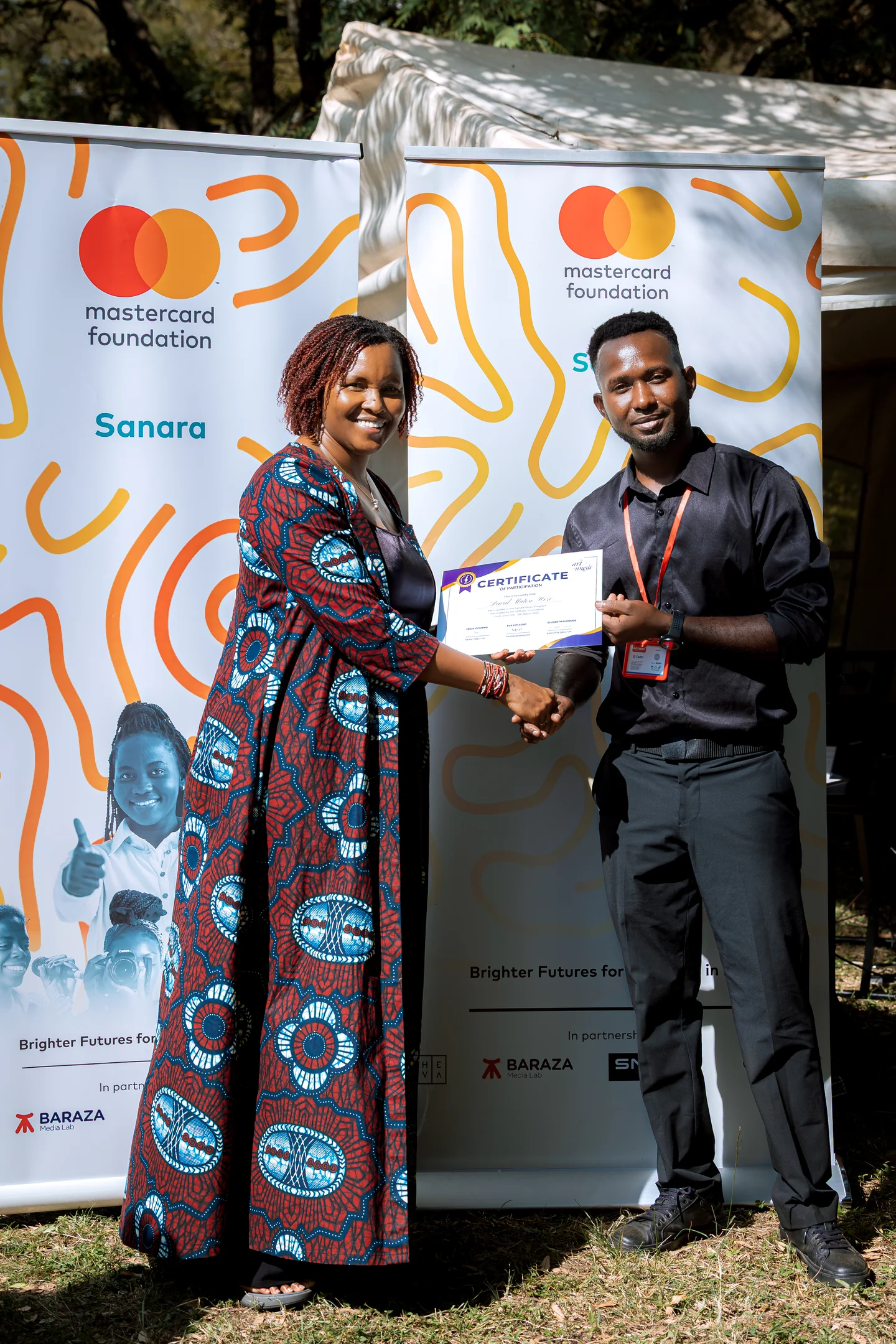
Sanara is a Mastercard Foundation programme delivered in partnership with HEVA Fund, SNDBX-Ubuntu, Baraza Media Lab and GoDown Arts Centre.