
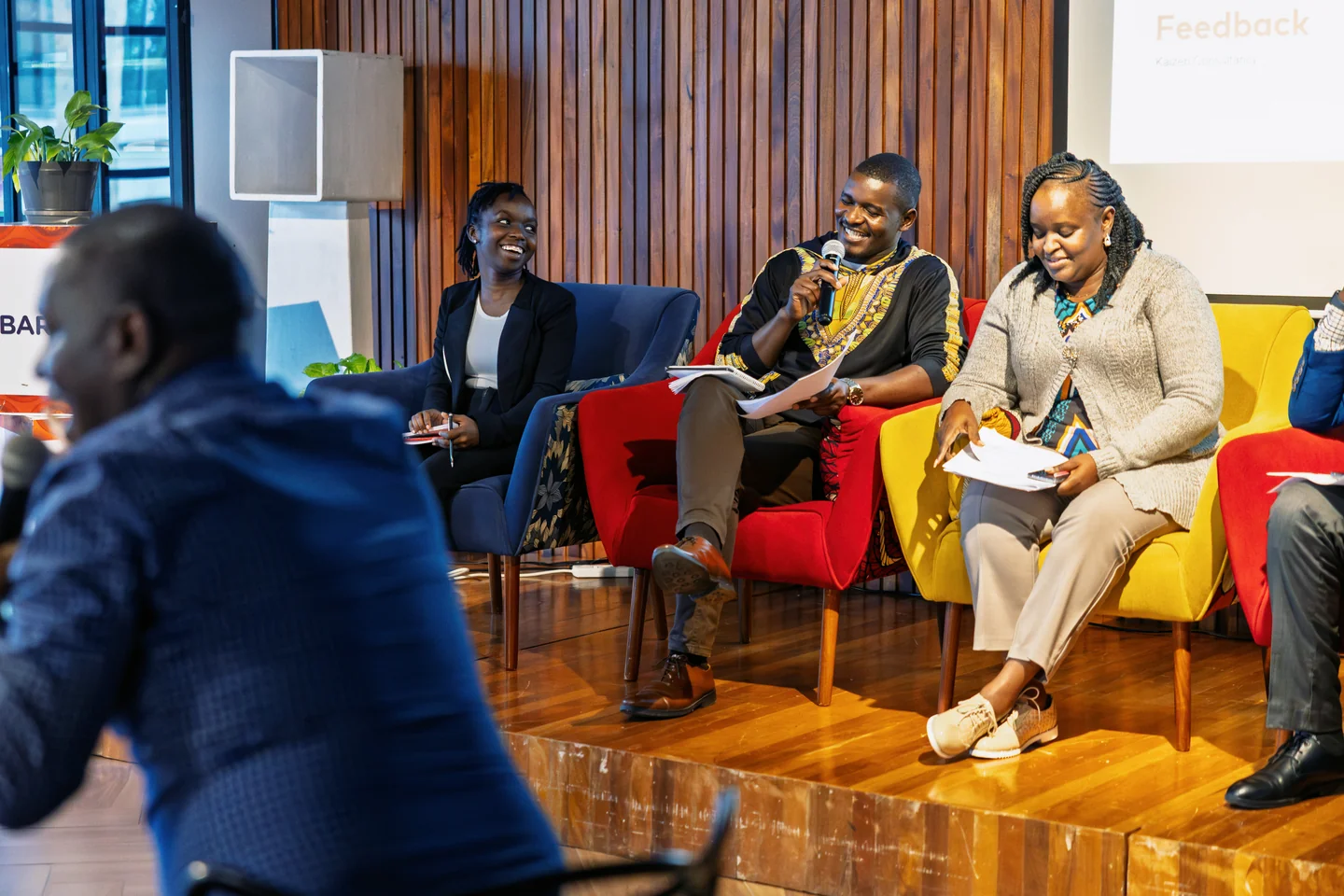
“I think we're not in a position to negotiate on women's safety.”
Would 80 per cent safety be a fair target for women working in the creative industries?
“Absolutely not. I would actually vouch for 100% safety. Only just because of what we've already gone through.”
She's with Re Records, a production and entertainment company, and has been through three Sanara courses: the Perform music incubator, artist management, and sound engineering. Hawa, a filmmaker who'd done Sanara's training for businesses under a year old, sat beside her. They'd just come off a panel at HEVA Fund's safeguarding community of practice, on 19 June 2025, a day set aside, the organisers said, for moving safeguarding “from policies to practices”.
They'd met that morning.
What the word means
What does safeguarding mean, in plain English? JJ gives the policy answer.
“Safeguarding is policy creation, design and implementation to ensure that all the programmes are providing safe spaces for the participants. And today specifically we are talking about taking those policies from paper to practice.”
Hawa: “Safeguarding basically means keeping you safe, be it mentally, physically, emotionally, just ensuring that you're safe.”
Overlooked
“One of the biggest safeguarding struggles and issues that I encountered would be discrimination due to my gender, especially because I work in a very male-dominated industry. So sometimes the struggles of having to be a woman in such a male-dominated industry tend to get overlooked.”
“You go to a creative space,” Hawa says, “and you're like, oh I have this movie, and the other guy does this, and the next day it's on Netflix and you're like, that was mine!”
HEVA's own gender inclusion and safeguarding lead, speaking the same afternoon, named a third: the informal deal. “You can perform and then we can pay you by exposure.”
Paper to practice
The participants on the panel had a complaint about the paperwork itself. Programmes hand them a safeguarding policy to sign, the lead reported afterwards, but don't give them time to read and understand what they're signing. They asked for a session, not a signature.
JJ wants the training aimed somewhere else too.
“Training not just for the women and teaching them how to stay safe and report any issues they have, but also training the male students, the men in the programmes, and how they can also create a safe environment for the women in those programmes.”
Hawa agreed, and pushed it further. “Because it's time that you stop putting the blame on the girl child. We should not only teach the girls how to protect themselves, we also teach the men.”
She also wants a person, not a number: a help desk, or an anonymous box, with someone trained behind it, “a psychologist there, and you tell them, oh, there's this and this and this going on, and they help you without really exposing you.”
JJ: “Normally when someone raises such a concern, they put up a hotline. But I like what you said because it creates a more personalised experience when you have someone trained to talk to.”
The law
Kenya's Employment Act requires an employer with twenty or more employees to issue a policy on sexual harassment, after consulting its staff. A 2025 symposium convened by the Employment and Labour Relations Court called for that threshold to be revisited. The International Labour Organization's Violence and Harassment Convention of 2019 reaches further: it covers trainees, interns, job seekers and the informal economy, and it asks for training and confidential complaint routes. Kenya voted for it in Geneva. It hasn't ratified it.
Pads and a creche
Three months earlier, at Filamujuani Foundation, a film-training school, staff had found out what safety looks like when it's practical. Women were missing classes when they had their periods, and mothers of small children couldn't come at all. They built a creche, and a kitty with pads, wet wipes and painkillers. In the previous cohort, they say, almost 40 per cent of the women had dropped out. With the creche and the kitty, about 2 per cent did.
Madelynn Nafula, a model in Mombasa, has her own way of putting what the industry demands. “You don't come into modelling kama hujiwezi kiroho. There are so many people who take advantage of models, especially event organisers.”
A hundred
Hawa came back to JJ's number before they finished.
“Maybe it does start with the men, like them becoming better people to work with and be in these spaces with. And then maybe, yeah, we can get to that 100%.”
Sanara is a Mastercard Foundation programme delivered in partnership with HEVA Fund, SNDBX-Ubuntu, Baraza Media Lab and GoDown Arts Centre.