
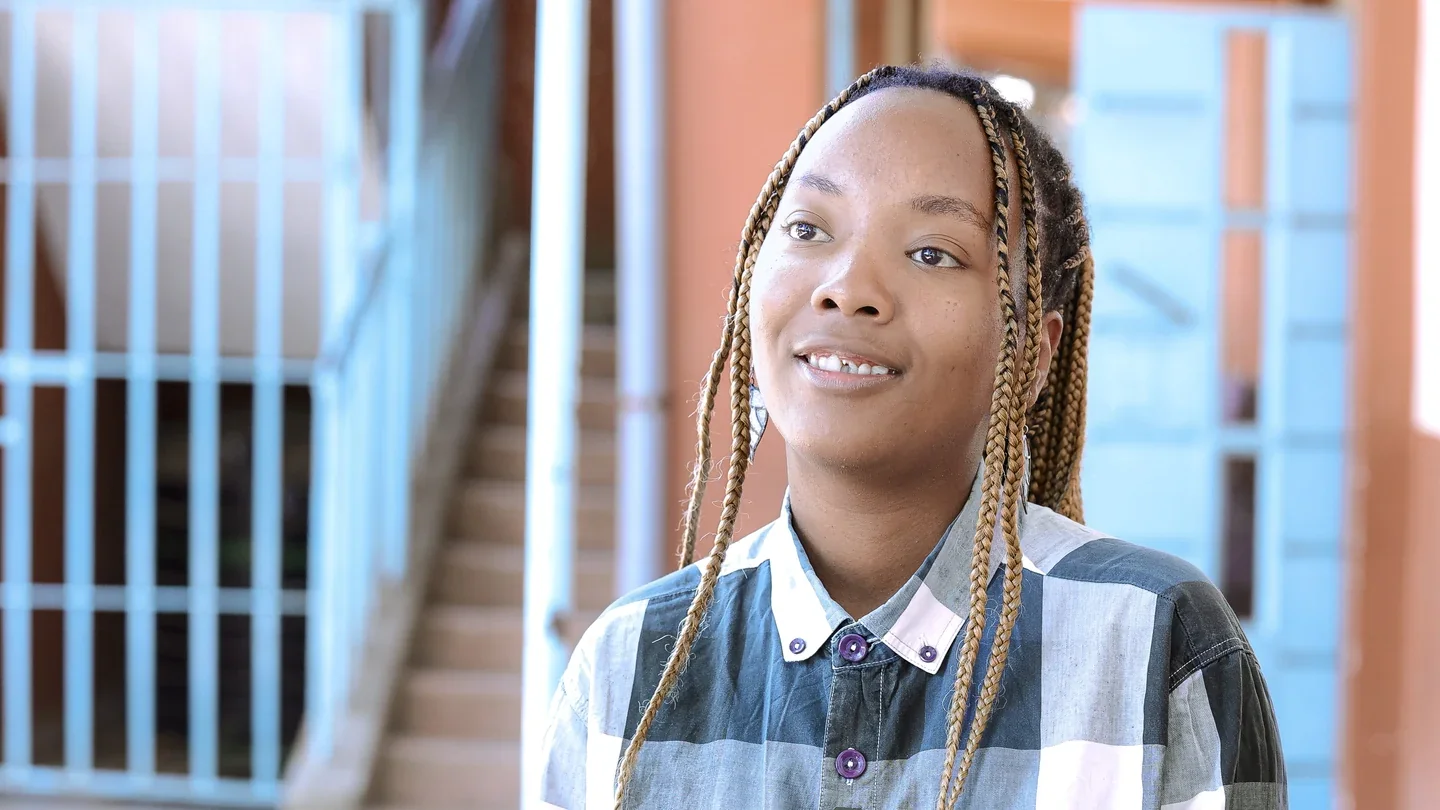
“Akianza kuona hiyo growth in you, at least unarudi na kitu kwa mkono. They set you free.”
That's the Kisumu Songbirds, in Kisumu, in June 2025. One of them had been caned in front of the chief for skipping class to make music. He still respects his mother's insistence that he finish school first. “Usipe muziki 100% then uwache shule ikae chini. Balance.”
The terms
DJ BigStar's father set his out early, in Nakuru.
“My dad used to tell us, I'm going to support you however I can. Any other thing that you would like to do you can do it your peke yako, like when you have your own money, if there's a skill you'd like to add, najilipia juu.”
So she waited until she could pay: school, then college, then work, then a three-month DJ course that she paid for herself.
DJ Agger's parents set theirs too: no DJing until the degree was done. She graduated in journalism and public relations in 2021 and started DJing in 2023.
“It's still mine. It's still a degree, it's still something I'm really proud of.”
Nicholas Macharia's parents wanted him in a classroom of a different kind. “They wanted me to study education and be a teacher.” He produces music in the studio at the Kenya Society for the Blind instead, and they haven't let it go. “Up to now, especially when things are not really going well, they usually tell me, ‘I think we told you you needed to do this.’”
The proof
In Kakuma, Gerrard Aoci's family stopped him going to practice. Then he won a rap battle and brought the prize home.
It was a FilmAid rap battle, and it paid 5,000 shillings as well.
“When I brought it home, that was like a sign. My brother now believed. 'Okay, so we are going to give you a chance to do music, but promise us that you're going to perform in school.' So performing in school was my ticket to keep on doing music.”
The prize was a speaker.
DJ Wiwa's first fee was a thousand shillings, on Valentine's Day.
“That thousand bob, my mom was the one who received it.”
It was her mother who'd suggested DJing in the first place. She also reminded her of a promise: the first salary would go to God. “And so I was forced to take the money to church.”
Said Yassin's father plays guitar in Dola Kabarry's band, and kept an ear on his son's chords. “He was like, ‘Hey, now you've played this and this chord. Wow. I can add you some.’” His mother took longer.
“Just recently is when she started seeing the fruits of my music game, my passion.” Now she asks, “Hauna fare? I can give you.”
The verdict
Grace Lavina's came by way of a dress. She'd turned up at her grandmother's with paint dried into her clothes from a job at the Kisima Festival in Kilifi. Her grandmother asked what it was, and Grace explained that it had come off the faces and onto her dress.
“She was okay with it. So if my grandma is okay with it, who are you?”
She gives the other reason too. “Everybody is okay with me doing art, because it generates money, actually.”
Madelynn Nafula's family don't wait to be told. “They're the ones who ask me, ‘Kwani hauna event? Kwani what are you doing? Mbona hutuambii pesa ya nguo?’”
Diana Kimwaki lived with her parents when the project work ended. Everyone else asked how she'd live.
“And at some point, I thought, ‘You know what? My parents are not stressing me, so I'm not going to allow you to stress me as well.'”
Nobody at the door
Damackline Oginda sang in a church choir in Kibera, and couldn't afford its uniform, or the fare to where it performed.
“I didn't have any support from both the family and friends.”
Her family “would not see it as something that would one day become what it is right now.” Some of what she was told, she says, was true. “I could not even sing on the keys.” So she copied vocal coaches' exercises from social media, and practised in private.
“I would call myself into a private space and talk to myself. I'm like, 'Dama, you have to do this and you will do it and you will make it to where you want to be.”
Gerrard has heard what's said about artists. “People believe you're someone who's not faithful, someone who maybe loves drugs, you know?” Parents, he says, keep children out of music for exactly that reason.
Kitu kwa mkono
The Songbirds were candid about what a parent is waiting for.
“Of course hakuna parent anaweza allow mtoto wake atembee tu ovyo ovyo kila saa unalala nje, saa usiku uko nje ati music. Alafu haoni kitu inarudi nayo.”
Victor Benson pays his rent through photography. “I also help at home, my mom and my siblings.” For June Masimoni, music is a passion and “ni kitu inafanya nipate maybe chakula kwa meza ama kitu ya kusaidia familia.”
Agger has the degree and the decks.
“It's still a degree. It's still something I'm really proud of... and I'm so glad that I got to do the two careers that I've always wanted.”
Sanara is a Mastercard Foundation programme delivered in partnership with HEVA Fund, SNDBX-Ubuntu, Baraza Media Lab and GoDown Arts Centre.