
“I do grips and lighting. And I'm so good at it. I'm a lady, but wait till you meet me on set.”
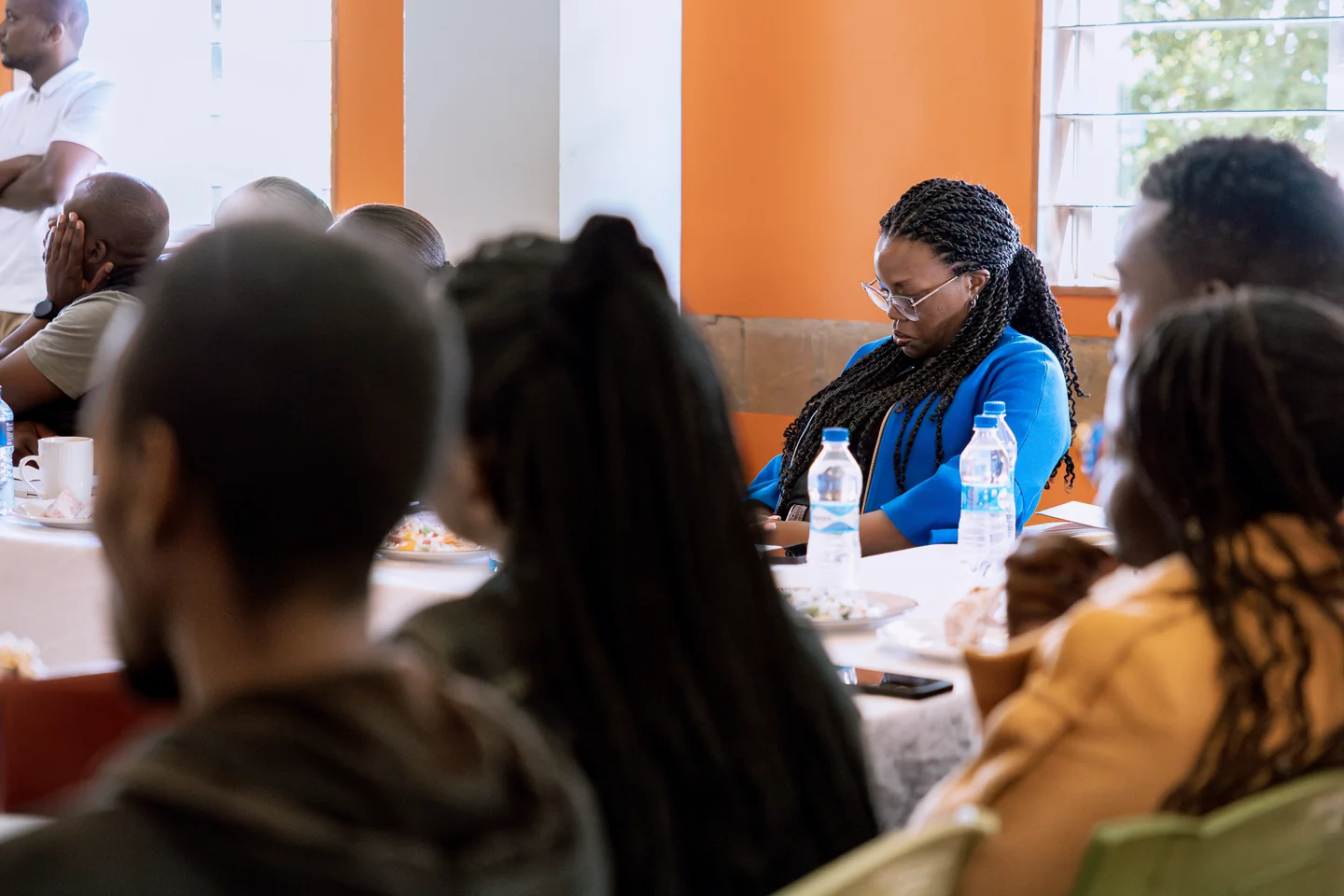
She'd finished her classes at Filamujuani Foundation two weeks earlier. She's a mother of four. On 13 May 2025 she was one of the alumni who stood up, one after another, to speak to a visiting team from the Mastercard Foundation's finance department, people who, as one of them put it, “look at numbers all the time”.
She told them first about the babysitter.
“Some of us were like, we can't make it because we have kids, our kids are young. And they were like, no, we'll give you a babysitter. And the babysitter was here from as early as seven, because the morning classes start at eight.”
At first she went to check on the baby a lot. Then less. “I don't have any excuses why are you not coming to school, why are you missing classes.”
Then she told them about the client. She and her team had found one themselves, the Kenyan arm of Black Market Records, and they'd shot a short film for its new film side.
“It will be out soon.”
A camera without a viewfinder
A sports photographer from the first cohort brought a portfolio. It started in 2020, during COVID, with a father's Nikon Coolpix.
“Imagine taking sports pictures without a viewfinder.”
The best of it: an accreditation from the Football Kenya Federation for a national-team match, one of about 40 photographers chosen. Then pictures from Kajiado, near the border with Tanzania: Maasai playing football among the cows, children sheltering from rain.
“As you can see, moments come up, you can tell stories from the pictures.”
A film was a movie
Someone else from the same cohort hadn't known film was a thing you could learn. “I just knew anything you watch on TV is a movie. So I was like, how do these people make these things?”
The training began in October 2024, twelve weeks of it, and the fees were a worry. “They told me, don't worry, it's a fully sponsored programme. What you have to do is just show up. That's what I did for the 12 weeks.”
“Right now I can operate a camera. But then I didn't know how to operate a camera.” After that morning, there was another meeting to get to, about a film just shot with them as director of photography for the first time.
The environment really matters
An animation student told the room about a condition he lives with, and why he'd told the school about it on the first day.
“One thing with the condition of epilepsy is that the environment really matters. The people you work with, it becomes like a therapy.”
When the call came offering him a place, he hadn't believed it. “Will I be given a chance to hold a camera?”
“Right now, at least, I'm confident enough to go and produce something that I never thought of.”
A space to dream
One of the co-founders of a production company started by women from Filamujuani read her speech, because she was too nervous to speak without it. She's a refugee as well as a filmmaker.
“Being a woman in film means constantly having to prove yourself every time, time and time again. And being also a refugee means carrying like an invisible weight, of displacement and of survival.”
“Filamujuani didn't just teach us how to hold a camera or edit films. It gave us voices, a platform, family. It gave us a space to dream, to heal, to build something of our own.”
Kenya hosted 879,452 refugees and asylum seekers at the end of September 2026, by UNHCR's count, about 119,000 of them in its towns and cities. Sanara set itself a target of 11,000 young refugees among the 110,000 people it means to reach.
Paid right
The visitors had questions too. One wanted to know whether anyone was making sure the young people weren't being underpaid for their passion. He had a friend, he said, who'd designed a logo for a supermarket chain years ago for very little, and was still trying to get paid fairly for it.
The foundation's answer was the job-placement scheme it runs for alumni.
“You have the skill, you have the right portfolio, but you're not able to price yourself. So you're either paid something that is way below what you actually deserve. So one of the things we've done is make sure that we rally behind our alumni to make sure they are paid right.”
When it places alumni, the foundation says, it negotiates their terms of reference, their working conditions and their pay, “so that we don't have our alumni working too much and getting paid too little.”
What got the grips and lighting technician's team its first client?
“Discipline, commitment and communication.”
Sanara is a Mastercard Foundation programme delivered in partnership with HEVA Fund, SNDBX-Ubuntu, Baraza Media Lab and GoDown Arts Centre.